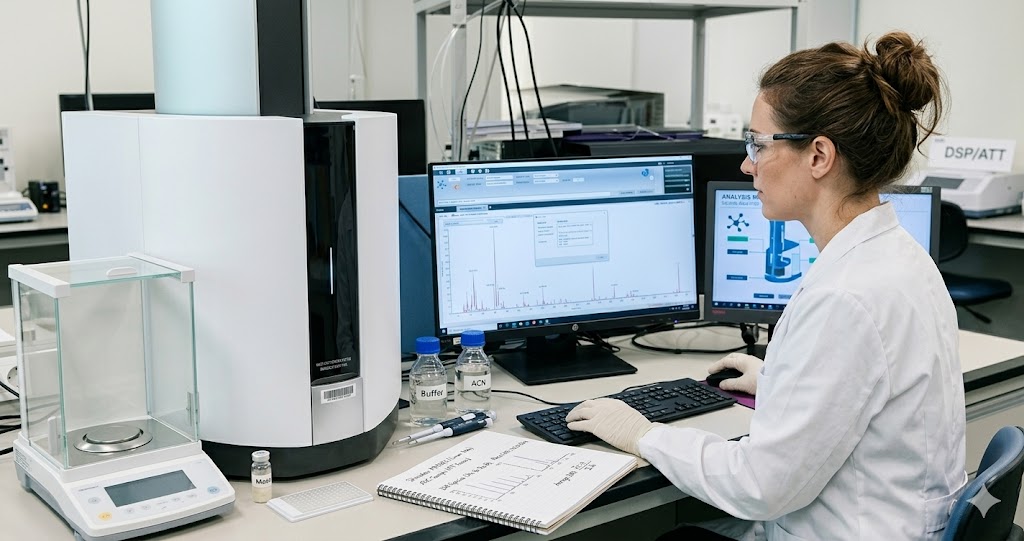
1. Technical Categorization of Analytical Mass Spectrometer Platforms within Downstream (ATT) Processes
Analytical platforms utilized for establishing bioprocess QC and regulatory approval data are precisely categorized based on their resolution and analytical objectives. Therefore, process engineers must optimize methods by considering specific equipment specifications and precision levels:
■ High-Resolution Accurate Mass Spectrometry (HRAMS) Configuration
This mass spectrometer specification is mandatory for measuring the intact molecular weight (Intact Mass) inherent to proteins. In addition, it is essential for deconvoluting micro-heterogeneity, such as complex N-glycosylation profiles.
■ Linear MALDI-TOF Mass Spectrometry Integration
This platform is highly optimized for ultra-fast monitoring of molecular weight ranges for large biomolecules. It is primarily implemented during intermediate downstream purification steps. As a result, it completely eliminates the need for complex Liquid Chromatography (LC) separation of the samples.
■ Triple Quadrupole Mass Spectrometry Deployment
This system is mainly operated in conjunction with standard LC networks. Engineers deploy it primarily for process residue analysis and the quantitative analysis of small-molecule payloads.
2. Global Trends in Rapid Mass Spectrometer Deployment and Pretreatment Optimization
Recent ATT workflows among global biotechs reveal a shift toward deploying benchtop-type, high-speed linear MALDI-TOF technologies. These tools serve as an in-line screening standard to complement heavy conventional LC-MS analyses and maximize overall efficiency. Consequently, strategically interconnecting compact, high-speed laser-based MALDI-TOF sub-platforms within the ATT category has emerged as a major new global trend.
■ Resolving Process Bottlenecks via Ultra-Fast Intact Mass Screening
Analytical lead time has traditionally been the greatest hurdle when monitoring real-time proteolysis and post-translational modifications (PTMs). To resolve this bottleneck, global process engineers are adopting innovative approaches that completely bypass complex LC separation steps. For example, modern high-speed solid-state laser systems mix desalinated protein or peptide samples with an appropriate matrix such as CHCA or SA. This process derives an accurate Intact Mass spectrum in under 5 minutes. Thus, it serves as a powerful in-line guide for immediately determining purification compliance before advancing the batch.
■ Quantitative Control Conditions Aligning with Industry Standards
Advanced mathematical controls during sample pretreatment are just as critical as hardware performance to achieve flawless reproducibility. In compliance with formal guidelines, matrix substances must be precisely measured down to trace micro-levels. This requires a 4-digit analytical balance or a high-performance analytical weighing balance. Furthermore, this process must take place inside a strictly controlled laboratory environment where temperature is maintained at 20±2°C and humidity at 40±5%.
Particularly when analyzing large macromolecular proteins, controlling the matrix-to-sample molar ratio precisely within the optimal range of 10,000:1 to 50,000:1 is the global standard protocol. This rigorous weighing ensures uniform co-crystallization. Additionally, it drives consistent desorption/ionization under laser irradiation, thereby maximizing target resolution.
3. Quantitative Mass Spectrometer Verification of Drug-to-Antibody Ratio (DAR)
Following antibody production, controlling the average number of drug molecules conjugated per single antibody represents the most critical Critical Quality Attribute (CQA). This metric must be tightly regulated during the linker-payload conjugation phase to comply with the latest FDA Guidance for Human Drug CGMP protocols.
■ Mass Shift Analysis and Quantitative Equation
The molecular weight of a naked antibody (IgG) is typically detected at approximately 150 kDa. As the linker-payload (approx. 1 to 1.5 kDa) conjugates to it, distinct mass spacing peaks are clearly observed according to the number of bound drugs. The standard mechanism for calculating the average DAR measures the ion intensity of each peak detected in linear mode using the foundational equation below:
Σ (n × In)
Σ In
• n : Number of drugs conjugated per single antibody (e.g., DAR 0, 2, 4, 6, 8, etc.)
• In : Ion intensity or peak area of the corresponding n-conjugate peak
High-speed linear mass spectrometry platforms utilizing high-energy Collision-Induced Dissociation (CID) reliably resolve individual DAR species. This pattern holds true even within random conjugation mixtures. Furthermore, this method shows an exceptionally high correlation with validation data from high-resolution accurate mass spectrometry.
4. Protocol for Establishing Finished Product Reference Standards
The workflow for drafting finished product reference standard specifications for Biologics License Applications (BLA) adheres strictly to standard analytical parameters. For further information on data criteria, developers should consult the official FDA CMC Guidance Hub. The standard protocol requirements are outlined below:
| Step | Standard Protocol Requirements |
|---|---|
| Trace Mass Measurement | Verify the weight of lyophilized reference standard pellets using the best analytical balance. Afterward, log the values permanently into digital records to maintain data integrity. |
| Mass Fingerprinting | Repeatedly measure samples extracted from the finished product lot. This ensures you register the unique protein Intact Mass and DAR profile spectrum into the instrument database as the master reference standard. |
| Tolerance Limit Settings | To establish release testing criteria for future commercial lots, fix and manage the acceptable tolerance threshold at ≤ ±0.2 DAR against the established reference standard. |
Conclusion and Process Recommendations
Benchtop high-speed mass spectrometry platforms deployed in downstream (ATT) workflows represent highly reliable in-line mass spectrometer systems. They are fully capable of rapidly validating exact protein molecular weights and DAR distributions. At the same time, they eliminate complex pretreatment steps. To satisfy heightened global regulatory expectations, these systems must be accompanied by accurate gravimetric analysis. In addition, robust cross-validation protocols are required. Therefore, it is highly recommended to integrate the quantitative equations and pretreatment conditions outlined in this technical brief directly into your facility’s Standard Operating Procedures (SOPs).
* Related Core Infrastructure Data: Learn more about our technical operations and platform scaling at Kyungeun M&S Internal Bioprocess Hub.
If you require professional tailored technical consulting on mass spectrometer-based protein molecular weight analysis, implementing global ATT chromatography process architectures, or securing cGMP Data Integrity, please contact our specialist division immediately.