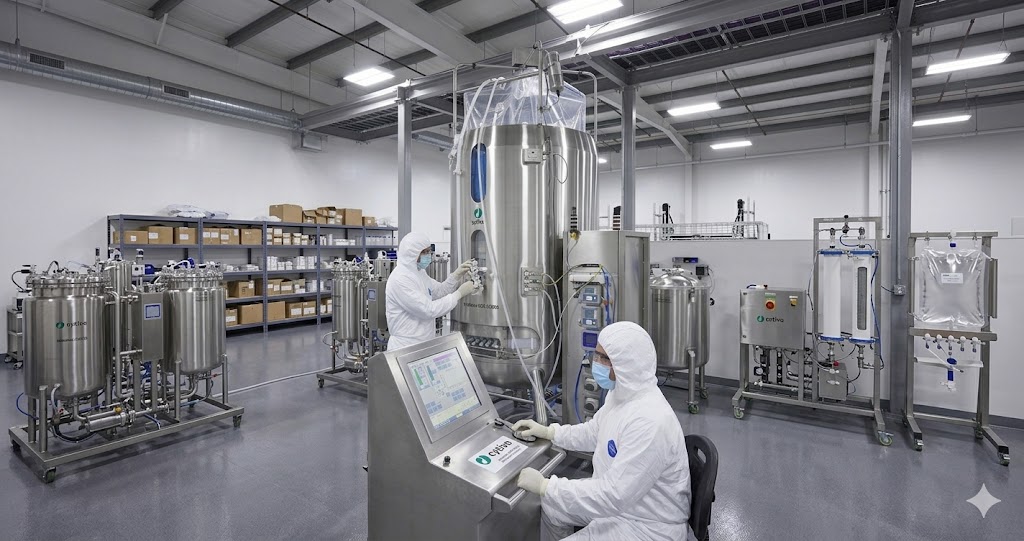
A pilot run that looks clean rarely stays clean at commercial scale. Mixing time, oxygen transfer, and heat exchange all behave differently once a vessel grows by an order of magnitude, which is exactly why the pilot stage exists — not as a smaller rehearsal of production, but as the step that has to predict what production will actually do.
What the Pilot Stage Is Actually Testing For
Before a process moves to a commercial tank, it needs to survive a jump in scale without losing the fluid dynamics, mixing behavior, and cell growth characteristics that were optimized at bench scale. Get this step wrong and the failure doesn’t usually show up as an obvious defect — it shows up as an unexplained drop in titer once the process reaches production volume, by which point the root cause is much harder to trace.
Single-use platforms have become the default choice for this stage specifically because they remove one major variable from that equation: cleaning validation. A single-use vessel doesn’t carry the risk of cross-contamination between campaigns the way a reusable stainless-steel tank does, which matters more in a pilot facility running multiple molecules through the same footprint.
How the Major Platforms Actually Differ
Three single-use platforms dominate current pilot-to-commercial scale-up work, and they’re not interchangeable — each solves a slightly different part of the scale-up problem.
Cytiva’s Xcellerex XDR line spans working volumes from roughly 10 L up to 2,000 L across a common vessel geometry, with a 5:1 turndown ratio at each size.[1] Keeping the same geometric proportions across scales is the point — it’s what allows process parameters tuned at a smaller size to transfer predictably to a larger one, rather than requiring re-optimization at every step up.
Sartorius’s Biostat STR platform takes a similar geometric-scalability approach, running from small development scale up to 2,000 L using Flexsafe STR single-use bags built on a proprietary multilayer film. Sartorius states that its resin formulation and extrusion process are controlled specifically to keep extractable and leachable profiles consistent from batch to batch — a detail that matters because inconsistent E&L behavior between bag lots is a real source of process variability that’s easy to misattribute to something else.[2]
Thermo Fisher’s HyPerforma single-use bioreactor line rounds out the mid-scale segment, commonly used in the 100 L to 500 L range with jacketed heating and cooling for facilities that need flexible thermal control without committing to a fixed stainless installation.
A Rough Comparison
| Platform | Scale Range | What It’s Specifically Built to Solve |
|---|---|---|
| Cytiva Xcellerex XDR | ~10 L – 2,000 L | Consistent geometry across scales for predictable scale-up |
| Sartorius Biostat STR | Bench scale – 2,000 L | Batch-to-batch consistency of single-use bag film (E&L control) |
| Thermo Fisher HyPerforma | Commonly 100 L – 500 L | Flexible jacketed thermal control at mid-scale |
Why This Connects to Data Integrity, Not Just Hardware
None of this scale-up predictability means much if the data behind a pilot run can’t be trusted during an inspection. FDA’s Data Integrity guidance expects CGMP records to be attributable, contemporaneous, and accurate throughout their lifecycle — which in practice means the control software running a bioreactor needs to produce a locked, traceable record of who changed what parameter and when, not just a clean-looking trend chart.[3] This is the same requirement that applies to equipment further upstream and downstream in the process — we go into it in more depth in our piece on equipment qualification and data integrity.
Where This Doesn’t Give You a Guarantee
Matching vessel geometry across scales reduces scale-up risk; it doesn’t eliminate it. Mass transfer and shear characteristics still shift with scale in ways that geometric similarity alone can’t fully predict, which is why engineering characterization data — mixing time, oxygen transfer rate, heat transfer — needs to be reviewed for the specific scale jump involved, not assumed from the platform name alone.
Platform choice is also not primarily a cost decision. Single-use systems carry ongoing consumable costs (bags, sensors) that reusable stainless systems don’t, and the tradeoff between capital cost and per-batch consumable cost depends heavily on run frequency and campaign length — a calculation worth doing for a specific facility rather than assuming one platform is categorically cheaper.
💡 KEY TAKEAWAY
Platform choice at the pilot stage isn’t really about which vendor’s bioreactor is “best” — it’s about which specific scale-up risk (geometric consistency, bag-to-bag variability, or thermal control) your process is most exposed to. Match the platform to that risk, not to brand reputation alone.
The Practical Takeaway
Choosing a pilot-scale bioreactor platform is really a decision about which scale-up risks you’re most exposed to — geometric consistency, bag-to-bag consistency, or thermal flexibility — and matching the platform to whichever risk matters most for a specific molecule and facility.
If you’re evaluating single-use bioreactor platforms or scale-up strategy for a pilot facility, feel free to reach out.