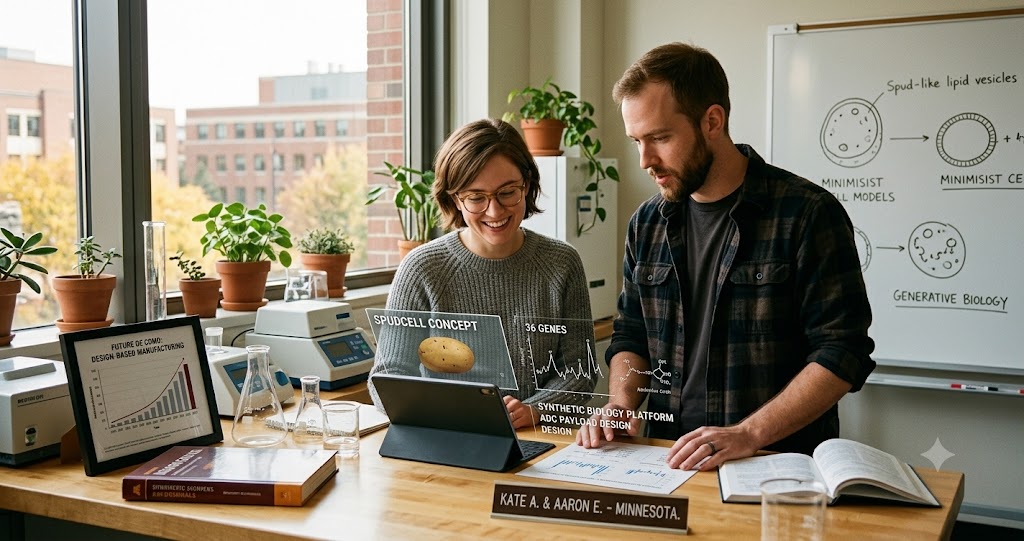
The World’s First Synthetic Cell: How SpudCell Could Transform Drug Discovery, ADC and Biomanufacturing
SpudCell is the world’s first synthetic cell assembled entirely from nonliving molecules that can grow, replicate, and divide through an engineered cell cycle.
On July 1, 2026, researchers at the University of Minnesota led by Professors Kate Adamala and Aaron Engelhart reported this breakthrough, which New Scientist, CNN, and Science highlighted immediately.
Many scientists describe this achievement as biotechnology’s “Sputnik moment.” Although SpudCell is not yet a fully autonomous living organism, it demonstrates for the first time that researchers can engineer fundamental functions of life from nonliving components.
Consequently, the implications extend far beyond basic science and could eventually reshape drug discovery, antibody-drug conjugates (ADC), contract development and manufacturing organizations (CDMO), and next-generation biomanufacturing.
What Is SpudCell?
SpudCell stands as the world’s first synthetic cell assembled from nonliving molecules that autonomously performs growth, replication, and division. Unlike previous artificial cell research that modified existing organisms, the team engineered SpudCell entirely from the bottom up using lipid membranes, synthetic DNA, proteins, and enzymes.
Therefore, this achievement successfully demonstrates that engineers can recreate essential functions of life through programmable biology. This opens entirely new possibilities for drug discovery, synthetic biology, and biomanufacturing.
1. Why SpudCell is Historically Significant: ‘Bottom-Up’ Cellular Assembly
Historically, traditional artificial cell research relied primarily on a ‘Top-down’ architecture. In that approach, scientists took an existing, living bacterial cell and sequentially removed non-essential genes. As a result, the point of origin always remained pre-existing life. Conversely, SpudCell represents a definitive breakthrough in ‘Bottom-up’ biological engineering. The team assembled it entirely in a test tube by organizing completely non-living chemical components. These basic building blocks included lipid membranes, synthetic DNA, specific proteins, and purified enzymes.
■ Programming the Pillars of Life with Minimal Genes
Utilizing only 36 core genes and approximately 90,000 base pairs, the research team programmed a functional cell cycle. This structure is extremely simple compared to traditional natural host cells like CHO cells or HEK293 cells. Nevertheless, SpudCell autonomously executed the fundamental pillars of life:
- ■ Feeding: The cell independently takes up and processes external nutrients.
- ■ Growth: The cell achieves physical expansion and developmental scaling of its structure.
- ■ Replication: The platform completes high-fidelity duplication of its engineered genetic architecture.
- ■ Division: The system autonomously executes cellular fission to conclude the cell cycle.
Therefore, this milestone represents the first time in scientific history that a completely artificial cell platform has successfully closed a full, engineered cell cycle.
Why New Scientist Called SpudCell a Historic Biotechnology Breakthrough
New Scientist described SpudCell as one of the greatest bioengineering achievements to date. This is because the team created the first synthetic cell from nonliving components that can successfully execute an engineered cell cycle.
For the first time, researchers demonstrated that engineered chemical systems can recreate key biological functions traditionally associated only with living organisms. Consequently, this finding fundamentally blurs the boundary between chemistry and biology. Furthermore, it may eventually enable programmable living systems.
2. Defining the Technical Limitations: A Machine-Life Hybrid
While SpudCell represents a profound milestone, a rigorous scientific assessment reveals distinct structural limitations. Consequently, these boundaries prevent us from classifying it as a fully autonomous living organism at this stage.
■ The Absence of Ribosomal Self-Biogenesis
First, the platform cannot independently manufacture its own ribosomes. As a result, operators must continuously supply active translational machinery from external sources to maintain protein synthesis.
■ Finite Replicative Capacity and Lack of Open Evolution
Second, cellular division naturally ceases after approximately 5 to 10 generations. The platform completely lacks the homeostatic maintenance found in biological cells. In addition, the artificial genome does not possess the intrinsic capacity for random mutation, adaptation, or open-ended evolutionary pathways.
Crucially, the investigators explicitly state they have not “created life.” Instead, they have “demonstrated that the core functions of life do not uniquely belong to natural biology.” This vital distinction effectively erases the traditional boundary between chemical machinery and biological entities. Furthermore, it signals the definitive onset of a new era in next-generation biomanufacturing.
3. The Structural Reconfiguration of the Biopharmaceutical Industry
Immediate commercial integration into pipelines will require continuous iterative research over the coming years. However, the opening of ‘Programmable Biology’ is already altering long-term industrial strategies. This optimization creates deep shifts across multiple sectors.
■ ① Paradigm Shifts in Drug Discovery
Traditional drug development timelines average 10 to 15 years. The commercialization of synthetic cell platforms compresses this early-stage research timeline significantly. By designing cells containing exclusively targeted genetic pathways, operators can build high-fidelity custom disease models. In addition, this platform enables automated drug screening and precise toxicity profiles, yielding profound results within oncology and advanced gene therapies.
■ ② ADC Infrastructure and Payload Diversification
The rapidly expanding Antibody-Drug Conjugate (ADC) market faces structural constraints regarding payload toxicity management. The current commercial landscape relies on a highly restricted selection of molecules, such as MMAE, DM1, and Topoisomerase I inhibitors. SpudCell introduces a novel mechanism to bypass these constraints:
- Non-Natural Amino Acid Incorporation: Synthetic cells can utilize non-natural amino acids. This directly enables the synthesis of entirely new classes of targeted cytotoxic payloads that do not exist in nature.
- AI-Driven Personalized ADCs: Integrating computational AI models with synthetic cellular execution allows for automated design. Consequently, developers can create customized antibody-linker-payload configurations tailored to patient-specific genetic variations.
- Microscopic Bioreactors: These platforms function as ultra-efficient, highly contained bio-factories. They can produce complex payloads, peptide APIs, and rare chemical intermediates without metabolic background interference.
■ ③ The Evolution of the CDMO Business Model
The global CDMO market—dominated by players such as Lonza, Samsung Biologics, WuXi Biologics, and Catalent—has driven competitiveness through raw bioreactor capacity (Capa). However, the maturation of synthetic biology will shift the primary competitive metric toward proprietary genetic design platforms.
| Industrial Axis | Traditional Operational Workflow | Future Synthetic Cell Infrastructure |
|---|---|---|
| Operational Paradigm | Cell line development → Scale-up → Commercial Production | Artificial Cell Design → AI Modeling → Digital Bio-Platform |
| Core Value Driver | Massive volumetric manufacturing capacity (Capa) leadership. | On-demand custom manufacturing & Biofoundry platforms. |
Consequently, the next decade will witness the emergence of specialized Synthetic Cell Foundries. These AI-native digital drug factories will prioritize absolute design control over physical facility scale.
■ ④ Green Transition in the Active Pharmaceutical Ingredient (API) Sector
Conventional small-molecule API manufacturing depends heavily on multi-step chemical synthesis, volatile organic solvents, and high-energy parameters. Conversely, synthetic cells decouple this process by executing molecular synthesis at ambient temperatures under low-carbon conditions. This transition offers a sustainable, highly scalable manufacturing alternative for peptide APIs and specialized ADC payloads.
4. Decadal Timeline: Future Technology Projections (2027–2040)
- 2027–2030 (Core Infrastructure Foundation): Corporate R&D scaling from the SpudCell framework will accelerate rapidly. Primary focus will center on engineering internal ribosomal biogenesis mechanisms. In addition, developers will extend replicative limits and build seamless integrations with AI drug discovery platforms.
- 2030–2035 (Early Commercial Integration): Stabilization of synthetic cell platforms triggers the initial commercial manufacturing of peptide APIs under ambient conditions. Concurrently, the first wave of non-natural amino acid payloads for next-generation ADCs will enter formal preclinical evaluation.
- 2035–2040 (Industrial Maturity): Widespread commercialization of fully functional Programmable Cell Factories will occur globally. Ultra-low-cost digital biomanufacturing will become the baseline standard. Consequently, the first therapeutic entities derived entirely from synthetic cells will enter clinical regulatory trial registries.
Frequently Asked Questions About SpudCell and Synthetic Cells
Many researchers describe SpudCell as an early platform for programmable biology because it demonstrates that key functions of life can be engineered from nonliving components. The biotechnology industry is gradually transitioning from an era of understanding biological systems toward an era of engineering and designing biology itself. If this technological trajectory continues, July 1, 2026, may ultimately be remembered as the moment humanity began to design biology rather than simply observe it.
If you require tailored technical consulting on global biotechnical architectures, advanced clinical data integration, or securing FDA data integrity compliance, please contact our specialist division.