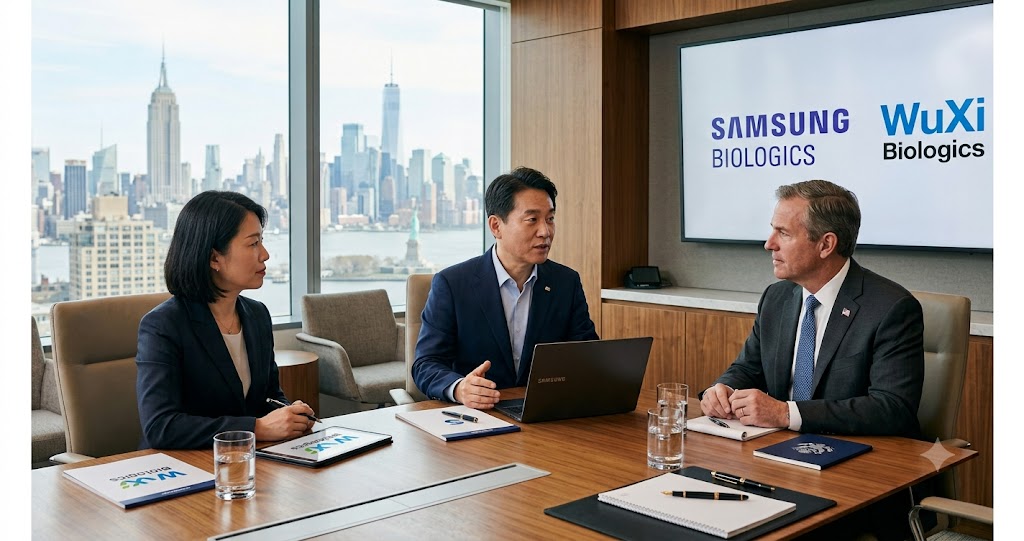
The Great Shift in Global Bio Hegemony:
Samsung Biologics vs WuXi Biologics, The CDMO Infrastructure Face-Off
In 2026, global pharmaceutical executives are watching one rivalry closely: Samsung Biologics vs WuXi Biologics. The question behind it is simple — what does a CDMO actually offer beyond lower manufacturing cost? For years, the CDMO model was treated mainly as a way to avoid the capital burden of building a plant. That framing has narrowed. Geopolitical trade friction, and in particular the U.S. BIOSECURE Act debate, has pushed the industry to weigh manufacturing location and supply-chain resilience alongside cost and quality.
This report compares the two companies’ core manufacturing and technology-transfer capabilities — Songdo-based Samsung Biologics and China’s WuXi Biologics — using publicly disclosed figures from each company’s own reporting, with source links so readers can verify the underlying data themselves.
1. The Bio-Security Backdrop: Why the Rivalry Intensified in 2026
CDMOs have long served capital-intensive pharma manufacturing by shortening time-to-market and reducing plant-construction risk. What’s changed is the political weight now attached to where that manufacturing happens. When the U.S. BIOSECURE Act was first proposed, many analysts expected it to sharply curtail China-based CDMOs and hand a windfall to Korean and Western competitors. The actual 2025 results tell a more layered story.
A Record Year, Despite Headwinds
In its full-year 2025 results, WuXi Biologics reported 209 newly signed integrated projects — a company record, and up from 148 in 2024. Roughly half of these new projects came from U.S.-based clients, a figure the company attributes to sustained demand for its bispecific and ADC manufacturing platforms. Notably, the latest version of the BIOSECURE Act, unlike earlier drafts, no longer names WuXi Biologics by company. Alongside this, WuXi is building out capacity outside mainland China, including a manufacturing hub at Tuas Biomedical Park in Singapore and a new Middle East site in Qatar (see Section 3).
Scale as the Core Value Proposition
Samsung Biologics operates Plant 4 in Incheon Songdo — commonly cited in the industry as the world’s largest single biomanufacturing facility — and is building out its Second Bio Campus, including Plant 5. This gives global pharma clients a manufacturing option based in a jurisdiction with no BIOSECURE-related exposure, which is part of why the company has positioned itself as a direct beneficiary of supply-chain diversification.
Source: WuXi Biologics 2025 Annual Results · FiercePharma coverage
2. Comparing ‘MSAT’ — the Less Visible Half of a CDMO’s Value
Plant size gets the headlines, but industry insiders point to a less visible function as the real differentiator: MSAT (Manufacturing Science and Technology). This team handles technology transfer — scaling a process from lab-bench volumes to industrial bioreactors without losing yield or quality along the way.
■ ① Samsung Biologics: Building Out MSAT Through Senior Hires
As of 2025, Samsung Biologics’ MSAT organization employed 297 people, including 16 PhDs. In March 2026, the company appointed Bram ten Cate — previously Global Head of MSAT at BioNTech, with earlier leadership roles at Roche and Sanofi — as Vice President of MSAT. The hire is part of a broader pattern of recruiting senior manufacturing and quality talent from established biopharma companies, which the company frames as reinforcing its position as complex modalities like ADCs make up a growing share of its production portfolio.
■ ② WuXi Biologics: A New Cell-Line Platform Built for Speed
WuXi Biologics introduced WuXia™ TrueSite, a targeted-integration CHO cell-line platform, during its 2025 reporting period. The company reports that the platform screens as few as 30 candidate clones, delivers mAb titers above 8 g/L, maintains over 99% expression stability across 60 generations, and supports a DNA-to-IND timeline of roughly 6 months. This platform underpins the company’s Singapore manufacturing hub, which is scheduled for commercial GMP release in the first half of 2026.
Source: The Bio News, on Samsung Biologics’ MSAT appointment · WuXi Biologics 2025 Annual Results
3. WuXi’s Diversification Play: Singapore and Qatar
WuXi Biologics’ response to geopolitical pressure has centered on building manufacturing capacity outside mainland China, across two separate moves.
3.1. A New Middle East Partnership: Qatar Free Zones Authority
In December 2025, WuXi Biologics signed a Memorandum of Understanding with the Qatar Free Zones Authority (QFZ) to establish the company’s first integrated CRDMO center in the Middle East. The agreement was signed by WuXi CEO Dr. Chris Chen and QFZ CEO Sheikh Mohammed Bin Hamad Bin Faisal Al-Thani. Both parties describe it as an early-stage partnership; as of this writing, WuXi has not disclosed a construction timeline, planned capacity, or investment figure for the Qatar site, so those details should be treated as pending rather than confirmed.
3.2. Complex Modalities as a Retention Strategy
While U.S. legislative attention has focused mainly on conventional monoclonal antibodies, WuXi’s growth in 2025 was concentrated in bispecific and multispecific antibodies and antibody-drug conjugates (ADCs) — about two-thirds of its 209 new project signings fell into these categories, and bi-/multi-specifics alone grew revenue more than 120% year-over-year. Once a molecule’s manufacturing process is developed on a specific platform, switching CDMOs mid-program becomes technically difficult and costly — which is part of why complex-modality expertise functions as a retention lever, independent of where the plant is located.
Source: WuXi Biologics–QFZ MoU announcement · WuXi Biologics 2025 Annual Results
4. Samsung Biologics’ Shift Toward Platform Licensing
Samsung Biologics has moved beyond pure contract manufacturing by developing and licensing its own proprietary antibody platforms — a step that changes its margin structure and its pitch to clients.
Samsung Biologics launched its bispecific antibody platform, S-DUAL, in 2022. The company reports a 99% heavy-chain/light-chain pairing success rate, attributed to the platform’s asymmetric structural design. In June 2026, the company said it plans to license S-DUAL and related antibody and ADC platform technologies directly to pharmaceutical clients — a business line separate from its core manufacturing services. Samsung Biologics’ longstanding position, consistent with the standard CDMO model, is that it does not develop its own competing therapeutics — a structural distinction that reduces IP-conflict concerns for clients, though it is a business policy rather than a regulatory or contractual guarantee.
Source: Samsung Biologics, S-DUAL launch announcement · Seoul Economic Daily, on the platform licensing business
5. Regulatory Trends Shaping Both Companies’ Roadmaps
Two regulatory trends are influencing how both companies invest, beyond the manufacturing footprint itself.
The FDA has increasingly emphasized real-time, verifiable data integrity across the manufacturing lifecycle rather than relying solely on retrospective audits. Both companies have publicly discussed digital and paperless quality-management initiatives as part of their manufacturing systems, though neither company has disclosed a quantified efficiency gain that we could independently verify — readers should treat any specific percentage improvement figures with caution unless the source company has published them directly.
Following pandemic-era shortages and ongoing trade tensions, multinational pharma clients increasingly favor having more than one qualified manufacturing site for critical products. Single-source geographic concentration is not, by itself, a statutory basis for BLA rejection, but it has become a practical risk factor that clients weigh when selecting a CDMO — a dynamic that benefits both Samsung Biologics’ centralized scale and WuXi’s expanding multi-country footprint, in different ways.
6. Where the Two Companies Are Headed
Based on the disclosures reviewed above, the two companies appear to be pursuing distinct strategies rather than competing head-to-head on identical terms.
| Strategic Focus | Samsung Biologics | WuXi Biologics |
|---|---|---|
| ① Platform vs. capacity | Licensing proprietary platforms (S-DUAL) alongside contract manufacturing at scale, targeting large late-stage and commercial programs. | Leveraging a fast cell-line platform (WuXia™ TrueSite) to win early-stage and mid-tier development programs before they reach commercial scale. |
| ② Geographic strategy | Centralized production concentrated in Songdo, South Korea, with expansion (Plant 5) at the same site. | Distributed footprint spanning mainland China, Singapore, and a newly announced (not yet built) Qatar site. |
A Market Redefining What CDMOs Compete On
The comparison between Samsung Biologics and WuXi Biologics shows a CDMO market where manufacturing cost is no longer the only variable. Geographic risk, platform technology, and MSAT execution now shape which company wins a given program. Samsung Biologics is building on centralized scale and platform licensing; WuXi Biologics is betting on a faster, geographically distributed model built around complex modalities. Both approaches carry trade-offs, and which one proves more durable will likely depend on how the regulatory and trade environment evolves over the next few years — not on either company’s marketing claims alone.
🎥 Leaders in Focus: MSAT with Bram Ten Cate
Bram Ten Cate, Vice President of MSAT at Samsung Biologics, discusses how process understanding, standardized workflows, and digital tools support technology transfer and manufacturing reproducibility.
This analysis is based on each company’s publicly disclosed press releases and media coverage. It is provided for general informational purposes and does not constitute investment or regulatory advice. Figures cited reflect the publication date and may change; readers should verify against primary sources before making any decisions.
Have questions about bioprocess engineering, cross-border cGMP deployment, or regulatory compliance strategy (QbD/PAT and paperless data infrastructure)? Reach out to our advisory team.
Connect with our network for ongoing bio-industry updates.