1. Why Global Biotechs Focus on CDMO Downstream Processing (DSP) Capabilities
For two decades, scale dominated the global contract manufacturing market. Mass bioreactor capacity always took precedence. Consequently, when searching for global cdmo pharma partners, biotechs asked one primary question. For example, they focused entirely on total cultivation capacity.
However, the global bio market environment is shifting rapidly. Therefore, the paradigm of this conversation is changing completely. First, the funding ecosystem for biotech companies is tightening. Second, supply chain risks are intensifying daily. At the same time, global pressures for drug price cuts are escalating.
In addition, regulation is driving this change. As of 2026, the FDA has raised the bar for substance purity. Thus, process Data Integrity reviews have reached the highest strictness in history. This prompts biotech decision-makers to focus on the other side of the facility. Consequently, they now look beyond upstream cultivation where cells grow.
Instead, companies rigorously audit advanced CDMO Downstream Processing capabilities. This is because proteins are isolated and filtered to high purity in this stage. Upstream processing generates raw volume. However, downstream processing dictates final drug yield and Cost of Goods Sold (COGS). Therefore, it determines the ultimate success of regulatory approvals.
■ The Cross-Contamination Threat in Multi-Product Facilities
In the past, biotech companies faced major risks with large outsourced facilities. Handling multiple client molecules simultaneously created immense anxiety. Specifically, their greatest fear was cross contamination examples from historical manufacturing failures. Cleaning massive stainless-steel columns took weeks of validation work. Furthermore, if cleaning validation failed, multi-million-dollar batches were ruined. Consequently, clinical timelines were pushed back by months. This catastrophic financial risk was borne entirely by the client.
■ 2026 FDA Guidelines and the Inevitability of CDMO Downstream Processing Platforms
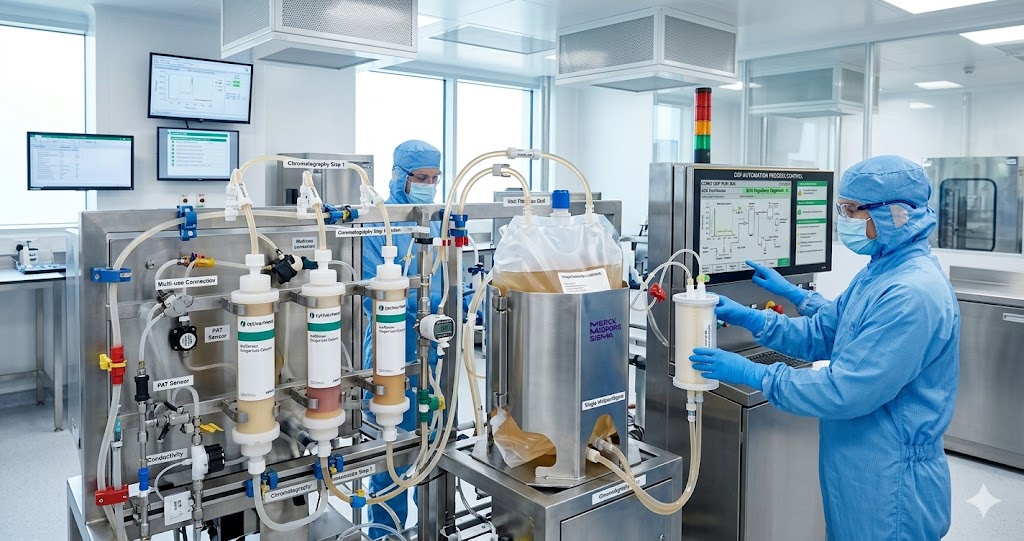
Recently, the FDA tightened inspection criteria even further. For instance, new guidelines demand strict traceability in multi-product facilities. Moreover, allowable limits for trace residues after equipment cleaning are now incredibly strict. Therefore, surpassing this regulatory hurdle with traditional fixed stainless-steel equipment is very difficult. At this crucial juncture, high-end Single-Use purification systems offer a clear solution. Specifically, systems led by merck milliporesigma (also called millipore sigma merck) have completely transformed this dynamic.
🔗 Regulatory Reference: You can review the FDA’s formalized inspection standards on multi-product facility controls via the official FDA Guidance Documents Portal.
- Business Fact: First, single-use flow paths eliminate historical manufacturing bottlenecks. Therefore, the risk of ways to prevent cross contamination issues during purification is physically controlled to near zero.
- FDA Regulatory Compliance and Client Benefits: Second, for US biotechs, this translates to unprecedented speed. CDMOs are completely liberated from submitting rigorous cleaning validation data to the FDA. Consequently, they can rapidly transition production lines. Thus, this drastically accelerates the target drug’s market launch. In conclusion, securing a top-tier purification skid serves as a powerful insurance policy. It protects client assets, secures timelines, and safeguards FDA approval.
2. Expansion of Modalities: Advanced Technical Prowess for High-Value Targeted Therapeutics
The global market is expanding rapidly. For example, pipelines are moving beyond conventional monoclonal antibodies. Instead, next-generation modalities are taking center stage. Consequently, global top-tier companies like boehringer ingelheim cdmo are investing heavily. Emerging pioneers are also dedicating resources to complex downstream processing infrastructures.
■ 2026 FDA Microscopic Reviews on Impurity Profiles
In 2026, the FDA is conducting microscopic reviews of impurity profiles. Specifically, they audit partial cultivation and purification processes very closely. This high regulatory pressure forces pharmaceutical innovators to validate their CDMO Downstream Processing architectures. For instance, this applies strictly to cell and gene therapies (CGT) and complex synthetic drugs. Therefore, systems must flawlessly filter out empty capsids. Furthermore, extracting pure target substances from intricate conjugate drugs is now the key to approval. Thus, in high-value long-tail segments, high-end downstream equipment dictates partnership success.
| Target Modality | Key DSP Bottleneck & Challenge | Strategic DSP Solutions & Impact |
|---|---|---|
| adc cdmo Capabilities | High-purity isolation of proteins without damage following linker and payload conjugation. | Advanced chromatography control capabilities are mandatory; minor resolution failures directly trigger FDA CMC risks. |
| viral vector cdmo / aav cdmo | Bottlenecks in Cell and Gene Therapy (CGT): Securing purification yield and full empty capsid removal. | Maximizing purification yield directly correlates with reducing commercialization Cost of Goods Sold (COGS). |
| oligonucleotide cdmo | Extracting pure target substances and maintaining purity within complex synthetic drug processing. | Securing cost competitiveness and satisfying FDA purity thresholds supported by precise continuous purification technologies. |
3. Data Integrity and Process Analytical Technology (PAT)
Digital tracking is a vital part of the 2026 inspection trend. For example, the FDA now directly audits the digital records of manufacturing facilities. Therefore, strict Data Integrity regulations absolutely prohibit any modification of raw data. This applies to real-time data for pH, conductivity, and protein concentration monitored throughout the CDMO Downstream Processing timeline.
■ Implementation of Automation Systems and Real-Time Controls
① Real-Time Process Analytical Technology (PAT)
High-end DSP systems feature seamless integration. For example, linking Process Analytical Technology (PAT) with automation software maximizes the overall reliability of manufacturing runs. Consequently, it reduces compliance risks significantly.
② Inspection Audits and In-line Buffer Systems
In-line buffer systems formulate concentrations in real time. Moreover, sensors record this data directly into centralized networks. Therefore, FDA auditors trust this process completely. It successfully prevents human errors and data omission risks.
Conclusion (The Bottom Line)
Strategic partnerships between biotechs and cdmo pharma have transitioned significantly. Specifically, the relationship has moved far beyond leasing factory space or cultivation tanks. Today, the two entities form a ‘core technology alliance’. Therefore, they share advanced purification techniques and strict FDA regulatory compliance capabilities.
The true competitiveness of market leaders does not lie in visible upstream facilities. Instead, it stems from bold investments in automated downstream processing equipment. This infrastructure physically eliminates cross contamination risks. Furthermore, it proactively fulfills heightened 2026 FDA purification standards.
In conclusion, biotech decision-makers must prioritize downstream processing capabilities when selecting partners. Reviewing regulatory compliance track records is also essential. Consequently, this is the clearest pathway to protect your budget, defend launch timelines, and deliver safe therapeutics to patients.
If you require professional tailored technical consulting on next-generation modality purification strategies,
implementing global chromatography process architectures, or securing cGMP Data Integrity, please contact our specialist division immediately.