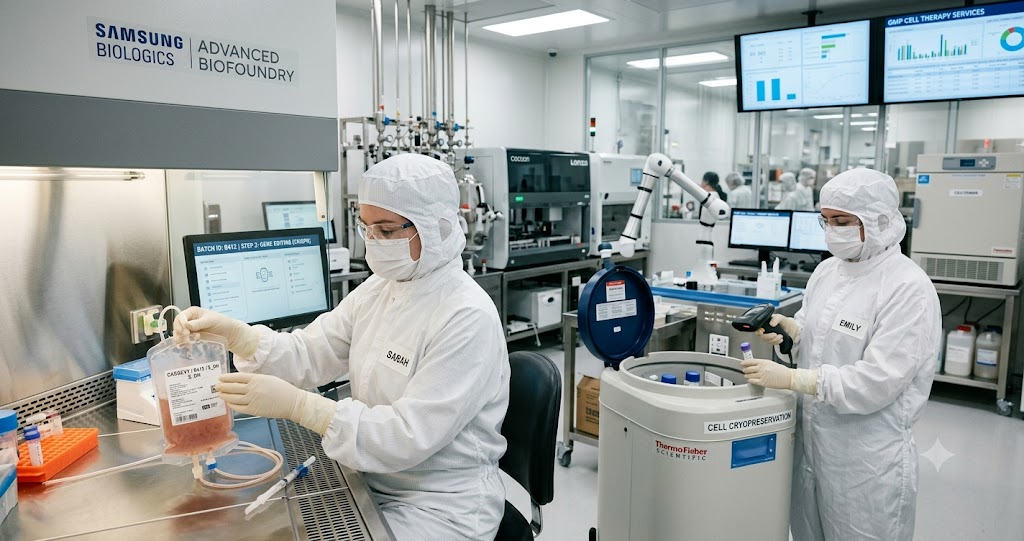
📌 TL;DR — Executive Summary
- What Changed: On July 1, 2026, the FDA expanded Casgevy’s approval from age 12+ down to age 2+.
- Why It Matters: This instantly adds ~5,500 eligible U.S. patients across 75+ authorized treatment centers.
- The Core Pivot: Because each autologous dose is custom-made from a patient’s own cells, manufacturing infrastructure—not drug discovery—now drives the entire industry value.
- Key Players Investing: Lonza, Thermo Fisher, Catalent, Charles River, PCI Pharma, Samsung Biologics, and WuXi.
- Future Outlook: Gene therapy, RNA therapeutics, and cell therapy are expanding in parallel, fully backed by shared digital biomanufacturing infrastructure.
Why Is Everyone Suddenly Searching for Cell and Gene Therapy Services?
Cell and Gene Therapy Services are booming in 2026 for one core reason: regulators have shifted from simply approving new therapies to actively de-risking their manufacturing. Search interest in this term isn’t driven by people asking what the service is, but rather why it has suddenly become the epicenter of biopharma investment.
Global agencies like the FDA and EMA have moved beyond evaluating individual pipeline molecules. Instead, they are actively supporting the critical infrastructure surrounding them—streamlining Chemistry, Manufacturing, and Controls (CMC) pathways, granting platform-technology designations, and implementing accelerated review timelines.
A prime example of this paradigm shift is the FDA’s Commissioner’s National Priority Voucher (CNPV) program, which compressed the pediatric review for the landmark therapy Casgevy to just 53 days from filing to approval, according to the FDA’s official press announcement. This combination of falling regulatory risk and surging deal activity defines the biopharma landscape this year.
The Turning Point: Sickle Cell Disease & Pediatric Expansion
Casgevy (exagamglogene autotemcel) is the single product that permanently put this category on the map. Originally approved in December 2023 as the world’s first CRISPR/Cas9 gene-edited therapy, it marked a historic milestone alongside Lyfgenia for treating sickle cell disease.
The breakthrough reached a critical inflection point on July 1, 2026, when the FDA approved a supplemental indication lowering Casgevy’s eligible age from 12 down to just 2 years old. This expansion covers young children suffering from both sickle cell disease with recurrent vaso-occlusive crises and transfusion-dependent beta thalassemia.
Co-developers Vertex Pharmaceuticals and CRISPR Therapeutics confirmed that this label expansion establishes Casgevy as the first genetic medicine accessible to young pediatric patient populations. This single regulatory decision unlocks a massive wave of immediate operational and manufacturing demand across a unified value chain:
➔
Gene Editing
➔
Manufacturing
➔
Commercialization
Why Manufacturing Matters More Than Discovery Now
In traditional pharmaceuticals, discovering the molecule was the primary commercial barrier. However, in advanced therapeutics—especially autologous (patient-specific) products like Casgevy—there is no such thing as “mass batch production.” Every single dose is a unique run manufactured exclusively for one specific patient. This fundamental reality has flipped the industry’s center of gravity entirely from R&D toward advanced manufacturing services.
■ The 6-Step Autologous Manufacturing Workflow
The complexity of Casgevy’s commercial production highlights why specialized manufacturing services have become an independent, multi-billion-dollar economic category:
- 1. Apheresis: Collecting the patient’s own hematopoietic stem cells at an authorized center.
- 2. Ex Vivo Modification: Precisely editing the target genes using CRISPR/Cas9 machinery.
- 3. Quality Control (QC): Executing rigorous, high-fidelity safety and release assays.
- 4. GMP Scale-up: Securing standardized, regulatory-grade cellular processing.
- 5. Cold-Chain Logistics: Transporting the living cellular product under cryopreserved parameters.
- 6. Infusion: Administering myeloablative conditioning chemotherapy followed by cellular transplantation.
Without a specialized CDMO partner capable of flawlessly executing all six steps at scale, even the most revolutionary science cannot reach a patient. This has led tier-one CDMOs—including Lonza, Thermo Fisher Scientific, Catalent, Charles River Laboratories, PCI Pharma Services, Samsung Biologics, and WuXi—to pour billions into scaling up dedicated cell and gene therapy biofoundries.
What Do Cell and Gene Therapy Services Actually Include?
| Core Capability | Critical Bottleneck Solved |
|---|---|
| Cell Line Development | Builds the stabilized base cells utilized throughout production workflows. |
| Viral Vector Development | Engineers high-efficiency delivery systems (e.g., Lentivirus, AAV) for genetic payloads. |
| Plasmid DNA Production | Supplies uniform, raw genetic material at optimized industrial scale. |
| GMP Manufacturing | Guarantees rigorous, regulatory-grade production compliant with global mandates. |
| Fill-Finish Services | Packages the final delicate, therapeutic cellular product securely. |
| Cryopreservation & Cold-Chain | Maintains absolute viability of living biological systems during transit. |
| Release Testing & Potency Assays | Analytically confirms real-world efficacy and safety profiles before clinical infusion. |
■ The Integration of Artificial Intelligence (AI)
AI is rapidly emerging as a powerful mechanism to decrease cost and pipeline failure rates. Though it remains an evolving framework rather than a universal standard, computational models are successfully restructuring several internal steps:
By leveraging AI-assisted tools, advanced services can now design safer viral vectors, forecast batch failures before they happen in the bioreactor, and introduce automated digital QC parameters that harmonize decision-making timelines.
The Outlook Beyond 2026: Multi-Modal Expansion
Data from the American Society of Gene & Cell Therapy (ASGCT) points to a collaborative future. Rather than one modality replacing another, gene therapy, RNA-based therapeutics, and cell therapy are projected to expand in parallel through the end of the decade, leaning heavily on shared digital manufacturing infrastructure.
Despite their clinical excellence, gene-edited blockbusters like Casgevy remain incredibly demanding. Treatment is far from a standard outpatient protocol—it requires intensive patient stem cell collection, high-risk bone marrow-destroying conditioning chemotherapy, and years of stringent follow-up tracking to monitor for delayed platelet recovery or engraftment failure. This inherent operational complexity is precisely why specialized manufacturing infrastructure, rather than basic discovery science, dictates commercial viability.
Frequently Asked Questions
The 2026 biopharma landscape highlights an undeniable transition: the industry is no longer constrained by our ability to map genetic mutations, but by our capacity to build reliable, high-fidelity biological therapeutics at an accessible cost scale. July 1, 2026, represents a milestone where advanced manufacturing frameworks officially solidified their position as the true engine room of next-generation personalized medicine.
References
- U.S. FDA. “FDA Approves First Gene Therapy for Young Children with Sickle Cell Disease.” July 1, 2026.
- Vertex Pharmaceuticals Newsroom. “Vertex Announces US FDA Approval for Expanded Use of CASGEVY.” July 1, 2026.
- BioSpace. “Vertex’s Casgevy becomes first approved gene therapy for young kids with rare blood disorders.” July 2, 2026.
- FiercePharma. “Vertex gains FDA expansion of Casgevy to those ages 2 and older.” July 6, 2026.
- Pharmacy Times. “FDA Expands Casgevy Approval to Children as Young as 2 Years.” July 8, 2026.
- Hematology Advisor. “Gene Therapy Casgevy Approved for Younger SCD and TDT Patients.” July 9, 2026.