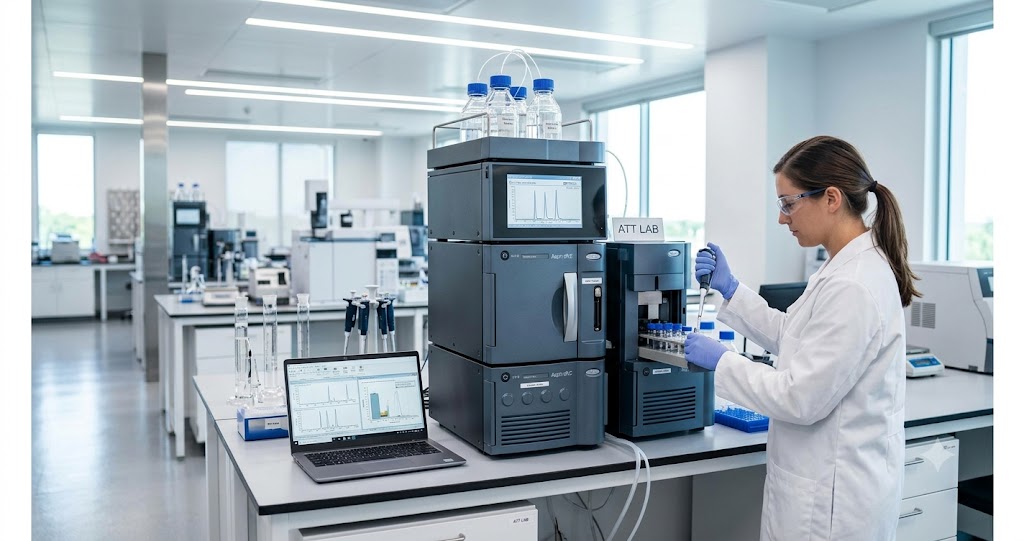
Every analytical department has a version of the same bottleneck: a large-scale cultivation run sitting on hold while a batch of samples works its way through the queue for impurity testing. The cost of that hold time compounds by the hour, and it’s a large part of why chromatography hardware — usually the least glamorous line item in an ATT (Analytical Technology & Testing) budget — has become a genuine strategic decision rather than a routine purchase.
The Physics Behind the Speed Difference
The gap between HPLC and UPLC isn’t a marketing distinction — it comes from a real engineering constraint that held chromatography back for decades. Conventional HPLC systems have historically been limited to a maximum operating pressure of around 6,000 psi (400 bar), which in turn limited how small a column’s packing particles could be. Waters’ ACQUITY UPLC platform was built specifically to break that ceiling, operating at up to 15,000 psi (1,000 bar) and enabling columns packed with sub-2-micron particles instead of the 3–5 micron particles typical of legacy HPLC.[1]
WHY SMALLER PARTICLES MATTER
Smaller stationary-phase particles increase the number of theoretical plates per unit column length. In plain terms: sharper, better-separated peaks in less time, at the cost of needing a system that can push mobile phase through that finer packing without excessive backpressure — which is exactly the problem the higher pressure ceiling solves.
The practical result is separations that once took 20–45 minutes per sample compressing down to a few minutes, and resolution good enough to distinguish trace degradation products or closely related impurities that would co-elute on an older system. For a lab running hundreds of release-testing samples a week, that difference in throughput directly determines how much production hold time a facility can avoid.
Where UPLC Alone Isn’t the Whole Story
A UV detector on its own — UPLC or HPLC — has a blind spot: components without a UV chromophore. Surfactants like polysorbate 20/80 and several lipid excipients used in LNP formulations don’t absorb UV light in a way that makes them easy to quantify without extra derivatization steps. This is why analytical departments increasingly pair a UPLC front end with charged aerosol detection (CAD) or refractive index detection (RID) to cover exactly those blind spots, rather than relying on UV absorbance alone.
For structural characterization rather than just quantitation — tracking post-translational modifications like deamidation or oxidation, or doing high-resolution peptide mapping — the same UPLC front end is commonly coupled directly to high-resolution mass spectrometry. This combination is standard practice for biopharmaceutical characterization precisely because chromatographic separation alone can’t confirm molecular identity; the LC step separates, and the MS step identifies.
What This Looks Like at the Regulatory Level
None of this technical advantage matters in isolation from how it’s documented. In March 2024, the FDA finalized ICH Q2(R2) (Validation of Analytical Procedures) and ICH Q14 (Analytical Procedure Development) — the first major update to analytical validation guidance in years, and notably the first ICH guidance to explicitly extend validation principles to advanced techniques like mass spectrometry and spectroscopic methods, alongside a shift toward science- and risk-based method development rather than a fixed checklist approach.[2]
The practical implication for equipment choice: a validated, widely-adopted platform makes it easier to build the kind of Analytical Target Profile and risk-based justification that Q14 now expects, and easier to defend that justification during an inspection. It also matters for tech transfer between sites — a chromatography data system like Empower or Chromeleon paired with a standardized instrument platform makes it far easier to demonstrate that a method transferred between two facilities is genuinely equivalent, rather than superficially similar.
The Comparison, Side by Side
| Parameter | Legacy HPLC | UPLC / UHPLC |
|---|---|---|
| Stationary phase particle size | 3.0–5.0 µm | Sub-2 µm |
| Maximum system pressure | ~6,000 psi (400 bar) | Up to 15,000 psi (1,000 bar) |
| Typical analysis time per sample | 20–45 minutes | Several minutes |
| Common detection pairing | UV, single detector | UV + CAD/RID, or coupled to high-res MS |
When Legacy HPLC Is Still the Right Call
Faster and more sensitive isn’t automatically better for every situation. A method already validated and filed on HPLC carries real switching costs — revalidation, comparability studies, and regulatory notification requirements that can outweigh the throughput gain, especially for a product close to the end of its development lifecycle where stability isn’t worth disturbing. UPLC’s advantage compounds most clearly in high-sample-volume environments — release testing queues, multi-product CDMO facilities — where the throughput gain multiplies across hundreds of samples a week. For a single low-volume legacy product, that math looks different.
How ATT Departments Are Actually Organized
“ATT” isn’t usually one team with one set of priorities — it’s typically split into two functions with different jobs and, often, different equipment needs. Samsung Biologics, for example, structures this as a separate Analytical Development function — responsible for method development, orthogonal characterization, and comparability studies — sitting alongside an independent Quality Unit that houses QC, which handles release testing, method transfer, and long-term stability testing.[3]
ANALYTICAL DEVELOPMENT
Priority: flexibility. Method development, orthogonal characterization, comparability studies. Tolerates multiple platforms and unlocked methods.
QUALITY CONTROL (QC)
Priority: standardization. Release testing, method transfer, stability testing. Needs validated, unchanging methods and high throughput.
A method-development lab benefits from flexibility — multiple platforms, room to experiment with orthogonal detection, tolerance for methods that aren’t yet locked down. A QC release-testing lab benefits from the opposite: standardization, validated methods that don’t change, and enough throughput capacity to clear a release-testing queue without becoming the bottleneck for batch disposition. Treating both functions as if they need the same equipment strategy is a common planning mistake — they’re solving for different things.
Why Equipment Choice Often Isn’t Fully the CDMO’s Call
A CDMO’s own platform preference matters less than it might seem once a client relationship is already underway, because equipment choice gets locked in during technology transfer — and technology transfer runs on equipment matching, not equipment optimization. A method developed at the client’s site on a specific instrument model often can’t simply be validated on whatever the CDMO happens to have; if that exact platform isn’t available at the receiving site, the method typically needs re-optimization before it can be used for GMP release testing.[4]
This is also the actual purpose of an “engineering run” — a non-GMP run performed at the CDMO before the first GMP batch, used specifically to confirm that the CDMO’s equipment produces performance equivalent to the originating site’s, not just similar in principle.[5] For a CDMO running multiple clients through the same facility, this creates a real operational tension: standardizing on one platform simplifies internal training and SOPs, but a multi-client, multi-molecule facility often ends up running several platforms in parallel simply because each client’s transferred methods were built around different original equipment.
The real takeaway: equipment strategy at a CDMO is shaped as much by whichever platforms its existing client base already validated on, as by what the CDMO’s own analytical team would ideally choose.
The Practical Takeaway
The choice between HPLC and UPLC isn’t really a hardware upgrade decision — it’s a decision about where hold time is actually costing a facility money, and whether an existing validated method is worth the switching cost to move. For new method development on a high-throughput line, the pressure and particle-size advantages of UPLC are well-documented and real. For an already-validated legacy method with low sample volume, the case for switching is weaker than the marketing usually suggests.
If you’re evaluating analytical platform strategy or method transfer planning for a biopharma manufacturing line, feel free to reach out.
Questions about UPLC/HPLC platform selection, orthogonal detection strategy, or ICH Q2(R2)/Q14-aligned method validation?
REFERENCES
- Waters Corporation. ACQUITY UPLC Columns technical brochure — system pressure and particle size specifications.
- U.S. FDA. Q14 Analytical Procedure Development — Final Guidance, March 2024.
- Samsung Biologics. Biologics CDMO Quality & GMP Services — Analytical Development and Quality Unit (QC/QA) organizational structure.
- Drug Discovery News. The CDMO Playbook: Navigating GMP Facilities and Outsourcing.
- Drug Discovery News. Negotiating Tech Transfer and Quality Agreements with Your CDMO.