What Is a CDMO, and Why Does Analytical Capability Matter So Much for ADCs?
A Contract Development and Manufacturing Organization (CDMO) executes process development and GMP manufacturing on behalf of a biotech or pharmaceutical sponsor. The scope of that partnership has expanded well beyond production: leading CDMOs are now engaged from early CMC (Chemistry, Manufacturing and Controls) strategy through regulatory submission support.
This shift matters most for complex modalities. An antibody-drug conjugate (ADC) combines three distinct components — an antibody, a linker, and a cytotoxic payload — into a single molecule. For a modality this complex, analytical capability becomes just as decisive a selection criterion as manufacturing capacity. To understand why, you first need to understand what a Critical Quality Attribute actually is.
What Is a CQA, and Why Is It Especially Demanding for ADCs?
A Critical Quality Attribute (CQA), as defined under ICH Q8(R2), is a physical, chemical, or biological property that directly affects a drug’s safety and efficacy. Put simply: a CQA is any attribute where drifting outside spec could put patient safety or clinical efficacy at risk.
Every biologic requires CQA control, but ADCs carry a heavier burden. Because a cytotoxic payload is chemically conjugated to the antibody, a CDMO must manage the antibody’s own quality attributes (aggregation, charge variants, and so on) while simultaneously controlling conjugation uniformity, payload distribution, and residual unconjugated material. Across the industry, regulators consistently expect the following six CQAs to be addressed for ADC programs.
| CQA | Definition | Risk if Uncontrolled |
|---|---|---|
| DAR (Drug-to-Antibody Ratio) | The average number and distribution of drug molecules conjugated per antibody | Efficacy variability, increased toxicity |
| Size Variants | Proportion of aggregates, fragments, and other size-related abnormalities | Immunogenicity, reduced potency |
| Payload Distribution | Conjugation site and positional distribution — can vary even when average DAR is identical | Batch-to-batch efficacy inconsistency |
| Naked Antibody (Unconjugated) | Fraction of antibody with no payload attached at all | Target binding without therapeutic effect — reduced efficacy |
| Free Payload (D0) | Cytotoxic material that remains unconjugated and free in solution | Systemic toxicity risk |
| Charge Variants | Distribution of acidic/basic variants relative to isoelectric point | Stability and pharmacokinetic shifts |
Important nuance: CQA priority shifts with antibody format, linker chemistry, payload class, and conjugation strategy. The six attributes above are a universal starting point — not a fixed checklist that applies identically to every ADC. The need for molecule-specific experimental verification is exactly what separates strong analytical CDMOs from the rest.
The Nine Instrument Classes Behind ADC’s Six CQAs
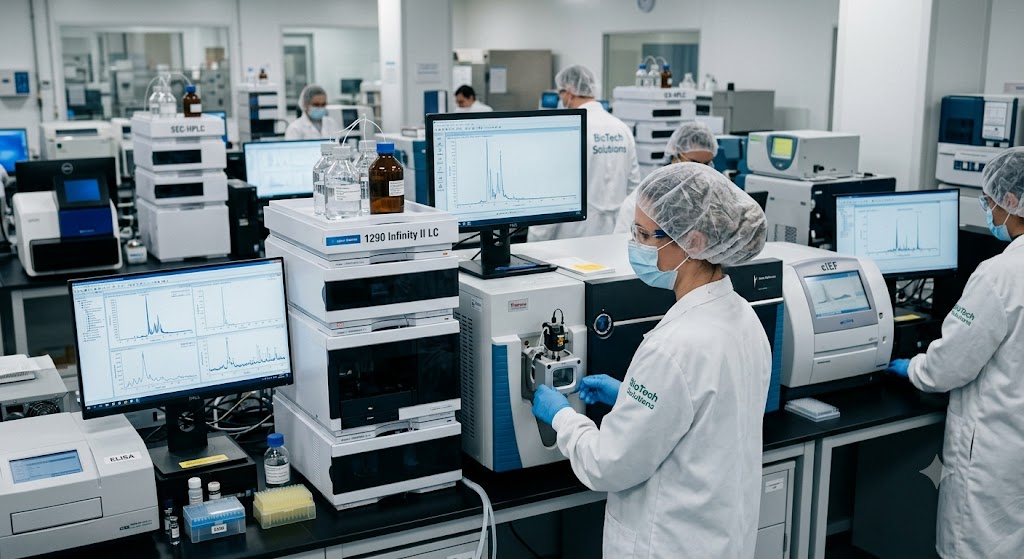
A CQA is a concept. Measuring it is a question of instrumentation and method. When evaluating a CDMO, the real diligence question isn’t “do they understand CQAs” — it’s “do they have the hardware and validated methods to measure each one?” Liquid chromatography, capillary electrophoresis, and mass spectrometry have become the predominant methods for ADC characterization across the industry. Mapped by manufacturing stage, the required analytical infrastructure looks like this.
Stage 01 — Analytical & Testing (ATT): CQA Quantification
| # | Instrument Class | CQA Measured / Why It’s Needed | Representative Vendors |
|---|---|---|---|
| 1 | High-Resolution LC-MS | Core tool for DAR determination and payload distribution mapping; intact and subunit-level analysis pinpoints conjugation sites | Thermo Fisher, Waters, Sciex |
| 2 | SEC / SEC-MALS | Detects aggregates and size variants; predicts storage stability | Waters, Agilent, Tosoh |
| 3 | CE-SDS / cIEF | High-resolution capillary electrophoresis profiling of charge and size variants | Sciex, Agilent |
| 4 | HIC (Hydrophobic Interaction Chromatography) | Profiles DAR distribution and payload hydrophobicity — one of the three pillars of ADC characterization alongside LC and MS/CE | Agilent, Tosoh |
| 5 | ICP-MS | Quantifies residual catalysts and heavy metal ions — a required element of toxicological safety data | Thermo Fisher, Shimadzu, Agilent |
| 6 | DLS (Dynamic Light Scattering) | Detects sub-visible particles and aggregation tendency; a formulation stability indicator | Malvern Panalytical, Horiba |
Stage 02 — Cell Line & Process Verification (USP / Pilot)
| # | Instrument Class | Why It’s Needed |
|---|---|---|
| 7 | qPCR-Based Cell Line / Viral Safety Testing | Screens for adventitious viral contamination and cell-line-derived impurities (HCP, HCD) |
| 8 | Nucleic Acid Quality Analyzer | Confirms expression-vector sequence integrity and mRNA/cDNA quality — the starting point for genetic stability verification |
Stage 03 — Final Release Testing (DSP)
| # | Instrument Class | Why It’s Needed |
|---|---|---|
| 9 | Cell-Based Potency Platform | Surrogate cytotoxicity/potency assessment via ADCC, ADCP, and CDC — verifies final biological activity and batch-to-batch consistency |
Beyond these nine, a full release package also includes anti-ADC-antibody immunogenicity testing, endotoxin testing, sterility testing, and bioburden testing — requirements shared across ADCs and conventional biologics alike.
How to Actually Evaluate CQA Verification Capability During CDMO Diligence
It’s common for due diligence to stop at manufacturing capacity and batch scale. But for a complex modality like an ADC, analytical verification capability is what actually determines your development timeline. FDA has published specific guidance addressing ADC development considerations, underscoring that this is a modality regulators evaluate with its own dedicated framework — not a standard biologic checklist. Consider asking a prospective CDMO the following four questions.
- Can all six core CQAs — DAR, size variants, payload distribution, unconjugated antibody/payload, and charge variants — be verified fully in-house, or are some outsourced?
- Does the CDMO understand that CQA priorities differ molecule to molecule, and do they have real experience building custom methods rather than applying a standard panel?
- Does their platform extend beyond ADCs to next-generation modalities such as antibody-oligonucleotide conjugates (AOCs) — reflecting real experience with newer conjugation chemistries like click chemistry and pH-sensitive linkers?
- Do they operate a quality system that bridges two very different regulatory paradigms: biologic specifications for the antibody and chemical specifications for the small-molecule payload?
A CDMO that can answer all four with specifics is functioning as a CMC strategy partner, not simply a manufacturing vendor.
Interpretation Comes Before Instrumentation
Any CDMO can buy the nine instrument classes above. Fewer can tell you, molecule by molecule, which CQA is likely to fail first and why — and defend that judgment in a regulatory submission. That judgment comes from running hundreds of ADC batches, not from a capital equipment list. When you shortlist a CDMO, ask them to walk you through a real CQA failure they caught and how they resolved it; the answer tells you more than any equipment tour.
Frequently Asked Questions
What does CQA stand for in pharmaceutical manufacturing?
CQA stands for Critical Quality Attribute — a measurable property (physical, chemical, or biological) that must stay within a defined range to protect a drug’s safety and efficacy, as outlined in ICH Q8(R2).
What is a CDMO?
A CDMO (Contract Development and Manufacturing Organization) is a third-party company that provides process development and GMP manufacturing services to biotech and pharmaceutical companies, often extending into CMC strategy and regulatory support.
How many CQAs does an ADC typically require?
Regulators consistently expect six core CQAs to be addressed for ADC programs: DAR, size variants, payload distribution, unconjugated antibody, free payload (D0), and charge variants — though the priority of each varies by molecule.
If your program is weighing exactly these trade-offs — which CQAs to prioritize, how to defend a control strategy to reviewers, or whether your current CDMO can actually run all nine instrument classes above in-house — that’s a conversation worth having early, not after a tech transfer is already underway.
If you require tailored technical consulting on CQA verification, analytical method development, or CDMO diligence for ADC programs, please contact our specialist division.