Key Summary
As of 2026, AI Drug Discovery has moved past the “era of hypothesis” and into the “era of clinical proof.”
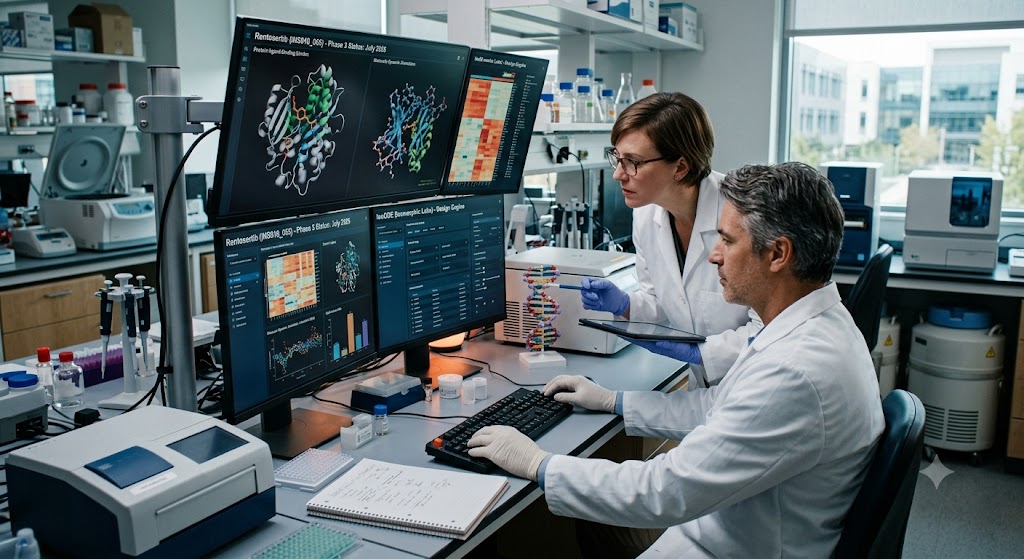
The clearest example is Insilico Medicine’s Rentosertib, a drug candidate whose target discovery and molecular design were both AI-driven, which entered Phase 3 clinical trials in July 2026 for idiopathic pulmonary fibrosis (IPF). Around the same time, Isomorphic Labs unveiled its next-generation design engine, IsoDDE, and is targeting clinical entry within the year.
This article is the opening overview of a series examining how AI is reshaping the entire biopharmaceutical development lifecycle.
What Is AI Drug Discovery?
AI Drug Discovery refers to an advanced computational approach that uses artificial intelligence and deep learning to accelerate the entire drug development lifecycle. Rather than acting as a simple assistant, AI actively drives critical phases including target discovery, molecular candidate design, ADMET (Absorption, Distribution, Metabolism, Excretion, and Toxicity) prediction, and clinical trial design optimization.
The operating logic of AI departs fundamentally from conventional methods. Traditional drug discovery relies on brute-force laboratory screening across millions of random chemical compounds. AI drug discovery instead uses generative models to design molecular structures with specific target properties from scratch.
The industry generally divides these methods into two branches:
- ■ Library Screening AI: Rapidly screens and prioritizes existing chemical compound libraries based on predicted target-binding affinity.
- ■ Generative Design AI: Uses diffusion models that start from random noise to generate entirely new molecular structures optimized for binding strength and structural stability. This branch is led by the RFdiffusion lineage that grew out of Google DeepMind’s AlphaFold architecture.
Where AI Fits Across the Drug Development Pipeline
Artificial intelligence has embedded itself into nearly every stage of drug development, turning traditionally linear processes into highly compressed, parallel workflows.
| Development Stage | Core Role of the AI Engine | Representative Example |
|---|---|---|
| Target Discovery | Multi-omics data and biomedical knowledge-graph analysis | PandaOmics (Insilico Medicine) |
| Molecular Design | Generative chemistry engines designing optimal structures | Chemistry42 (Insilico Medicine) |
| Structure / Binding | Predicting protein-ligand interactions at atomic resolution | AlphaFold 3, IsoDDE (Isomorphic Labs) |
| ADMET Prediction | Early-stage automated screening for absorption, toxicity, etc. | Proprietary core AI models (various biotechs) |
| Clinical Trial Design | Digital twins and Real-World Data (RWD) alignment | Unlearn.AI platforms |
| Manufacturing (CMC/GMP) | Process optimization, anomaly detection, automated QC | Qai Engine (Catalent) |
Note: Company and product names above reflect publicly available information as of July 2026; individual pipelines may change.
According to a case study Insilico Medicine published in Nature Biotechnology, the timeline from TNIK target discovery to preclinical candidate nomination took roughly 18 months. Rentosertib emerged from this pipeline and
entered Phase 3 clinical trials for idiopathic pulmonary fibrosis (IPF) in July 2026, a dramatically compressed timeline compared with conventional drug-development pipelines.
Around the same time, Isomorphic Labs unveiled
IsoDDE (the Isomorphic Labs Drug Design Engine), a unified drug-design system that reportedly more than doubles AlphaFold 3’s accuracy on protein-ligand structure prediction.
What’s Coming Next in This Series
This overview kicks off a series that will dig into six areas in depth. Links will be added as each entry is published.
① Global Top-Tier Company Matrix
Compares technology, clinical pipelines, and market strategy across Google DeepMind/Isomorphic Labs, Insilico Medicine, Recursion, Generate Biomedicines, and Xaira Therapeutics. Read the full comparison →
② FDA & EMA Global Regulatory Tracks
Analyzes the 10 Guiding Principles of Good AI Practice jointly issued by the FDA and EMA in January 2026, and how they apply in practice. (See “References” below for the original document.)
[Coming soon — link will be added on publication]
③ AI Across Modalities
Examines how AI is being applied to antibody-drug conjugates (ADCs), monoclonal antibodies, RNA therapeutics, and cell/gene therapies.
[Coming soon — link will be added on publication]
④ Strategic Shifts in the CDMO Market
Tracks AI integration and market shifts across global CDMO leaders including Lonza, Samsung Biologics, WuXi Biologics, Catalent, and PCI Pharma.
[Coming soon — link will be added on publication]
⑤ Next-Generation AI-Driven Clinical Trials
Investigates how digital twins and virtual control arms are restructuring clinical trial operations.
[Coming soon — link will be added on publication]
⑥ Forecasts Toward 2035
Presents data-driven scenarios and industry timelines based on current technological trajectories.
[Coming soon — link will be added on publication]
Key Takeaways
- A shift to pure design: AI Drug Discovery is shifting the foundational model from random laboratory screening toward explicit “molecular design.”
- Tangible clinical validation: Insilico Medicine’s Rentosertib reached Phase 3 clinical status in July 2026, setting a precedent for end-to-end AI-originated therapeutics.
- Regulatory alignment: The FDA and EMA jointly finalized their AI Guiding Principles in January 2026, establishing an institutional framework for clinical submission pathways.
- CDMO operational upgrades: Global CDMOs are racing to build AI-driven quality control and automated manufacturing capabilities.
- A realistic macro timeline: Despite faster computation, industry leaders emphasize that broad, systemic therapeutic impact still requires a realistic 7-to-10-year development cycle.
Frequently Asked Questions
Q. What is AI Drug Discovery?
It’s a computational approach that uses AI and deep learning to accelerate the entire drug-development lifecycle, from target discovery through clinical trial design. Instead of random screening, generative models design molecules with specific desired properties from scratch.
Q. Why does Rentosertib matter?
It’s a leading example of an AI-driven drug candidate — from target discovery to molecular design — and entered Phase 3 trials for IPF in July 2026, marking a milestone for AI-originated drugs in late-stage clinical testing.
Q. How is IsoDDE different from AlphaFold?
AlphaFold 3 focuses on protein structure prediction. IsoDDE goes further, predicting which molecules can bind to a target and produce a therapeutic effect. It was unveiled in February 2026.
Q. When were the FDA/EMA Good AI Practice guidelines released?
On January 14, 2026, as a set of 10 non-binding principles that set regulatory expectations for AI use across the drug-development lifecycle.
Q. When will AI drug discovery’s market impact become widespread?
Individual pipelines are moving faster, but industry leaders expect a realistic 7-to-10-year cycle before broad market impact becomes visible.
The computational frameworks of 2026 show that AI integration is no longer an optional optimization layer — it’s the infrastructure next-generation medicine is being built on. The next installment in this series will cover: [AI Market Analysis: From Isomorphic to Xaira].
References
- Insilico Medicine, “Insilico Initiates Phase III Clinical Trial for Rentosertib” (July 7, 2026, PR Newswire)
- Isomorphic Labs, “The Isomorphic Labs Drug Design Engine unlocks a new frontier”
- EMA, “EMA and FDA set common principles for AI in medicine development” (January 14, 2026)
- FDA/EMA, “Guiding Principles of Good AI Practice in Drug Development” (January 2026, original PDF)
For tailored technical consulting on global biopharmaceutical architecture, advanced clinical data integration, or FDA data-integrity compliance, please reach out to our specialist team.