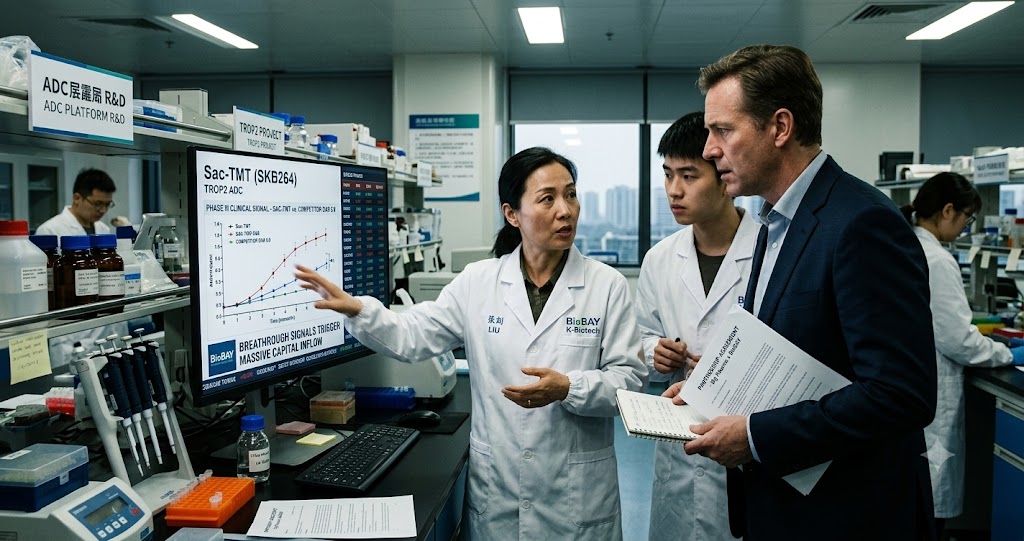
1. Suzhou BioBAY by the Numbers: Scaling Global Biotechnical Architectures
Established in 2007 within the Suzhou Industrial Park (SIP)—just a 30-minute high-speed rail journey from Shanghai—BioBAY has spent nearly two decades evolving into a fully integrated, self-sustaining biocluster. According to the latest official market data, the ecosystem’s operational capacity stands as follows:
A highly concentrated network specializing in novel drug discovery, advanced in vitro medical devices (IVD), and cell and gene therapies (CGT).
In the first quarter of 2026 alone, approximately 4 distinct novel therapeutic assets originated within BioBAY were successfully out-licensed to global multinational pharmaceutical corporations.
BioBAY’s structural advantage lies in its vertically integrated architecture. By bridging the gap between early-stage target screening, preclinical validation, clinical development, scalable biomanufacturing, and cross-border commercialization within a unified geographical boundary, it delivers an efficiency model that is exceptionally rare outside traditional Western hubs like Boston or San Francisco.
2. The Shift from Manufacturing Hub to Global Innovation Origin
The historical perception of the Chinese pharmaceutical market as a secondary source for generic medications or basic contract manufacturing (CDMO) has comprehensively dissolved. Total cumulative out-licensing deal volume from Chinese biotechs to global multinational pharmaceutical corporations hit a record high of $137.7 Billion USD. This represents a staggering ten-fold expansion, proving that the node of global biotechnical architectures is expanding fluidly into alternative tech hubs.
Global Big Pharma’s aggressive deployment of capital into Chinese innovations is driven by three distinct strategic imperatives:
- Operational Velocity: Chinese biotechs have significantly compressed the timeline from target discovery to Investigational New Drug (IND) clearance compared to traditional Western R&D pathways.
- Capital Optimization: Global rights to high-quality, high-probability-of-success pipelines can be secured at a highly optimized R&D cost structure.
- The Patent Cliff Imperative: With primary blockbuster assets across metabolic diseases, oncology, and immunology facing sweeping patent expirations over the next several years, the aggressive acquisition of external clinical assets has transformed into a core survival strategy for multinational executives.
■ Major Cross-Border Transactions & Capital Deployments
| Acquirer / Partner | Asset / Collaboration Scope | Financial Structure & Volume |
|---|---|---|
| AstraZeneca × CSPC & Metabolic Assets | AI-driven chronic disease research framework executed, followed by an expansive deal for next-generation obesity and metabolic pipelines. | Up to $18.5 Billion USD total potential value |
3. The Epicenter of the ADC Revolution: Modern Global Biotechnical Architectures
Antibody-Drug Conjugates (ADCs) deliver cytotoxic payloads directly to malignant cells via specialized chemical linkers, neutralizing tumor architectures while shielding healthy tissue. Because premature payload release triggers systemic toxicity and insufficient release completely destroys therapeutic efficacy, the absolute baseline of ADC engineering rests upon the precise structural design of the linker-payload architecture. Chinese innovators now account for the majority of newly executed global ADC licensing transactions. Within BioBAY and its adjacent networks, two dominant platforms have emerged, showcasing how localized engineering transforms global biotechnical architectures:
■ Kelun-Biotech: Irreversible Conjugation via OptiDC & Kthiol Platforms
Kelun-Biotech (HKEX: 6990.HK) anchors its therapeutic pipeline on its proprietary OptiDC platform, utilizing specialized Kthiol bioconjugation chemistry to forge an irreversible bond between the antibody and the linker. Its core clinical asset, the TROP2-targeted ADC known as Sac-TMT (SKB264/MK-2870), pairs a pH-sensitive cleavable linker with a novel topoisomerase I inhibitor payload, achieving a stable Drug-to-Antibody Ratio (DAR) of 7.4.
■ MediLink Therapeutics: Dual-Cleavable Mechanisms via TMALIN
MediLink Therapeutics, operating directly out of BioBAY, addresses the therapeutic index through its proprietary TMALIN (Tumor Microenvironment Activable LINker-payload) architecture. While traditional ADC platforms rely exclusively on intracellular lysosomal cleavage following receptor-mediated endocytosis, TMALIN introduces a highly sophisticated dual-cleavage mechanism active within both the extracellular tumor microenvironment and the intracellular lysosome.
By decoupling payload release from strict cellular internalization requirements, TMALIN drastically expands the selection of viable target antigens and accelerates deep penetration into dense, poorly vascularized solid tumors. Their standout B7-H3-targeted candidate, YL201, utilizes this framework to achieve a homogeneous DAR of 8.0, securing a licensing agreement with Roche worth up to $570 million in upfront and near-term milestone payments.
■ DualityBio: HER2-Targeted Expansion via DITAC
DualityBio established its clinical presence via its proprietary DITAC (Duality Immune Toxin Antibody Conjugates) platform, generating the third-generation HER2-targeted ADC asset, DB-1303. In 2023, DualityBio entered an exclusive licensing and collaboration agreement with BioNTech for DB-1303 and a second ADC asset, receiving $170 million upfront with additional development, regulatory, and commercial milestone payments potentially totaling over $1.5 billion.
While both pioneers confront the universal engineering problem of maximizing blood plasma stability while optimizing intratumoral payload release, their core strategies diverge: Kelun-Biotech prioritizes chemical irreversibility via its Kthiol conjugation chemistry, while MediLink engineers spatial liberation via extracellular-intracellular dual cleavage.
4. Predictive Trajectory: The Structural Evolution of Biotech Ecosystems
By weaving the preceding data points into a singular cohesive trajectory, the biopharma evolution over the next five years operates on a highly predictable orbit. This shift represents more than a baseline expansion in transactional volume—it marks a complete reconfiguration of the industry’s operational playbook.
■ Structural Paradigm Shifts & Architectural Reshaping
-
Evolution of Transaction Topologies (2026–2027):
With 2025 out-licensing volume hitting $137.7 Billion USD and average deal sizes swelling by 76% in early 2026, the velocity of standalone asset acquisitions will inevitably hit an operational ceiling. As validated by AstraZeneca’s sprawling CSPC alliance, Big Pharma is transitioning from simple out-licensing to complex joint developments, equity cross-investments, and the physical internalization of localized R&D footprints in China. The objective has shifted from capturing a single asset to preemptively locking down entire discovery engines and subsequent pipelines. -
The Patent Cliff Imperative Through 2030:
This structural integration will be permanently locked into place by a looming macro-timeline. Industry analysts estimate that blockbuster assets representing more than $200 Billion USD in annual global pharmaceutical revenue will face patent expirations through 2030. Consequently, external pipeline ingestion has transformed from an opportunistic expansion choice into a baseline survival imperative, anchoring the long-term pipeline dominance of Chinese discovery nodes for years to come. -
The Paradigm Shift in ADC Selection Dynamics:
The competitive axis is rapidly moving away from single cytotoxic agent optimization. As shown by Kelun’s irreversible conjugation chemistry and MediLink’s spatial tumor-activated linkers, the next round of oncology leadership will be decided by spatial and quantitative engineering—specifically, *where, when, and how payloads can be liberated*. Platforms possessing differentiated linker-payload architecture will hold meaningful leverage at the global Big Pharma negotiation tables over the next 3 to 5 years. -
Biopolitical Bifurcation & Operational Role Splitting:
Geopolitical barriers have not halted cross-border capital flow, but they are reshaping structural execution. The BIOSECURE Act, incorporated into the FY2026 National Defense Authorization Act and signed into law in December 2025, restricts U.S. federal agencies from contracting with designated “biotechnology companies of concern.” This friction, however, is not diluting BioBAY’s fundamental target discovery efficiency; rather, it is locking in a permanent **Bifurcated Industry Standard**. Moving forward, early-stage target screening and initial clinical validation will remain densely concentrated within localized Asian clusters, whereas late-stage scale-up, regulatory registrational trials, and commercial manufacturing will be cleanly partitioned into Western operational boundaries.
Conclusion: Navigating a Polycentric Global Biotech Landscape
Ultimately, the profound structural maturation of Suzhou BioBAY marks the transition of the global life sciences sector toward a permanently polycentric ecosystem. While established Western hubs like Boston continue to lead in foundational discovery output, BioBAY has successfully cemented its status as an equal co-innovation node. Over the next five years, this cluster will completely shed its designation as an “emerging hub,” transforming instead into a foundational, permanent asset pipeline that continuously dictates the commercial realities of global oncology and targeted medicine.
Bastille Post, “BioBAY Incubates 500+ Biotech Corporations” (April 2026)
Reuters, “China biotech licensing boom to hit record in 2026”
South China Morning Post, “Chinese drug makers strike record $136 billion in out-licensing deals”
Kelun-Biotech, PR Newswire — OptiDC/Kthiol platform, SKB264 DAR 7.4
MediLink Therapeutics, PR Newswire (Jan 2026) — TMALIN/YL201 Roche licensing deal
BioNTech SE, Official Investor Release — DualityBio DITAC/DB-1303 licensing terms
BioPharma Dive, “Big pharma’s looming threat: a patent cliff of ‘tectonic magnitude'”
Goodwin Law, “Final FY 2026 NDAA Includes BIOSECURE Act Provisions”
If you require tailored technical consulting on global biotechnical architectures, advanced cross-border ADC data integration, or securing data integrity compliance, please contact our specialist division.