Why ADC Analytical Automation Is Suddenly Biopharma’s Hottest Topic
For years, automation in pharma meant robotic arms bolted onto the production line. In 2026, the real transformation is happening somewhere less visible: the quality control lab and the process-development bench.
The reason is structural. Next-generation biologics — antibody-drug conjugates (ADCs), bispecific antibodies, multi-payload constructs — are far more structurally complex than a standard monoclonal antibody, and that complexity can’t be verified with the old workflow of manual sampling, offline HPLC runs, and expert-by-expert peak interpretation. The industry is now racing to fuse hardware automation with analytical automation into one continuous pipeline.
Market data reflects this shift. The global LC-MS (liquid chromatography-mass spectrometry) market grew from roughly $7.73 billion in 2025 to $8.83 billion in 2026, a 14.2% annual growth rate, with the expansion tied to rising biologics development, automated analytical workflows, and AI-assisted data interpretation layered on top of the instruments themselves.[1]
The ADC Bottleneck: Why One Number (DAR) Is So Hard to Pin Down
A standard monoclonal antibody is relatively uniform. An ADC is not — it’s a three-part molecule combining an antibody, a chemical linker, and a cytotoxic payload. The critical metric is DAR (Drug-to-Antibody Ratio): how many drug molecules are attached to each antibody, and where.
This number is notoriously unstable. Published research on cysteine- and lysine-linked ADCs found that apparent DAR values can fluctuate by as much as 0.6 units depending on the sample preparation workflow — desalting steps, disulfide-reduction time, sample concentration, and even how long the sample sits before analysis all shift the measured result.[2] In other words, the analysis method itself has become inseparable from the quality claim being made about the drug.
Two concrete technical developments illustrate where the field is heading:
- Fully robotic “self-driving labs.” A published platform integrates a liquid-handling robot, a vacuum filtration system, a seven-degree-of-freedom robotic arm (built around a Kinova Gen 3 arm), a thermo-shaker, and a precision balance into a single deck that runs an entire ADC conjugation reaction unattended, then automatically calculates DAR from the resulting chromatography data — closing the loop between synthesis and analysis without a human in between.[3]
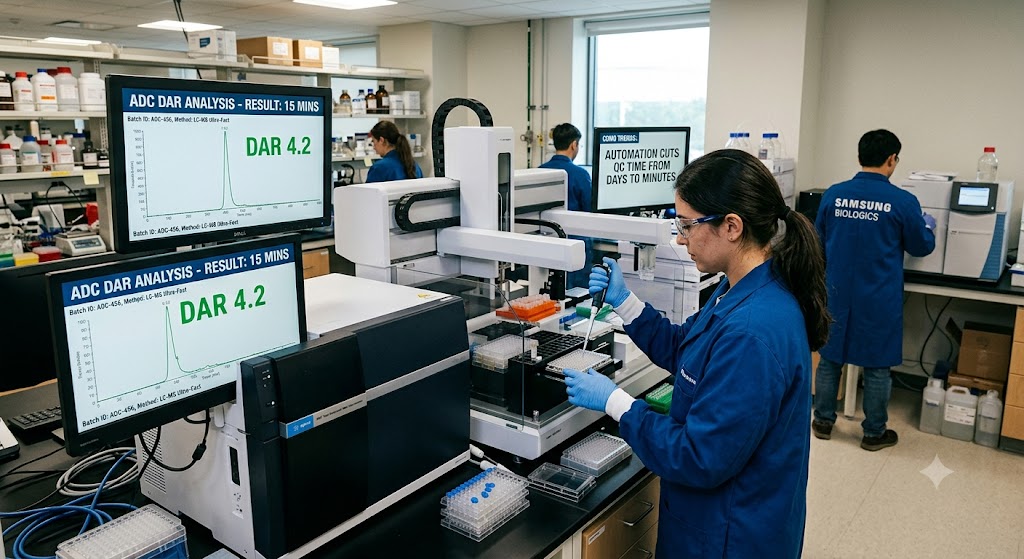
- Real-time DAR analysis in 15 minutes. A separate study combined rapid antibody deglycosylation with LC-MS detection to bring total DAR analysis time down to about 15 minutes, letting researchers adjust conjugation conditions in real time instead of waiting on results, compared with legacy workflows built around offline sampling, manual reagent handling, batch LC-MS runs, and manual peak interpretation.[4]
Regulators Are Pushing the Same Direction: PAT
This isn’t purely a corporate efficiency play. The FDA has been steering the industry toward real-time analytics since 2004 through its Process Analytical Technology (PAT) guidance, which encourages manufacturers to measure critical quality attributes during production rather than relying solely on end-of-batch testing.[5] In practice, that means chromatography, spectroscopy, and mass-spec sensors wired in-line or on-line directly into the manufacturing process, continuously monitoring critical parameters instead of waiting on a pulled sample.
That regulatory direction only works if the analytical instruments themselves can keep pace — which is exactly the gap the current wave of lab automation is trying to close.
Instrument Makers Are Racing to Keep Up
At ASMS 2026, Agilent showcased a Multi-Attribute Method (MAM) solution built specifically to support adoption of LC/HRMS in regulated biopharmaceutical quality control environments, integrating software, instrumentation, and consumables into a single workflow alongside its OpenLab data systems.[6] The broader instrument market is moving the same direction: rising demand for real-time monitoring modules and high-throughput systems capable of handling biosimilars and complex biologics, reflected in a global mass spectrometry market projected to keep growing at a mid-to-high single-digit CAGR through the early 2030s.[7]
Part of the urgency is a workforce problem. A persistent shortage of skilled mass spectrometry specialists is widening the gap between labs that can afford to scale up automation and those that can’t, turning automation capability into a genuine competitive moat rather than a nice-to-have upgrade.
Case Study: What “Automated ADC Analytics” Looks Like at Samsung Biologics
Rather than talk about automation in the abstract, it’s worth looking at how a major CDMO structures ADC analytical work today. Samsung Biologics operates a standalone bioconjugation facility built specifically for high-potency API (HPAPI) handling, physically separated from its other biomanufacturing operations and using isolator technology to meet strict occupational exposure limits while protecting product integrity.[8]
On the analytics side, the company doesn’t rely on a single method for something as sensitive as DAR. According to a 2025 technical overview from the company’s ADC analytical team, it runs up to four distinct techniques depending on the molecule: hydrophobic-interaction chromatography (HIC) for native ADCs with distinct conjugation patterns, reverse-phase (RP) chromatography for conjugation products under reducing conditions, UV-vis spectroscopy, and mass spectrometry — with MS also used specifically for conjugation-site determination and disulfide-bond analysis.[9]
The company frames its full service, from cell line development through drug substance formulation, as a roughly 14.5-month integrated timeline, explicitly designed so that conjugation development, analytical characterization, and manufacturing aren’t siloed across separate vendors — a fragmentation that industry technical staff have pointed to as a common source of quality-control friction across the sector.[9]
Case Study: Automation Beyond the Lab — Celltrion’s “Physical AI” Push
Celltrion is pursuing a broader version of the same idea, applying automation across its manufacturing footprint rather than just the analytical bench. The company has been building a company-wide “AI transformation” framework spanning R&D, production, and office operations, and plans to accelerate AI-powered smart factories at new API production facilities in Songdo, South Korea.[10]
That plan centers on introducing autonomous logistics robots, automated warehouse systems, collaborative robots, and intelligent manufacturing management platforms. Automation efforts are starting with repetitive, standardized processes first, with plans to expand AI into more advanced areas such as quality control and production optimization over time — and the company is separately reviewing humanoid robots as part of a longer-term vision for next-generation unmanned manufacturing.[10]
The new Songdo plants being built as part of Celltrion’s roughly $800 million capacity expansion are designed from the ground up around these automation and smart-factory systems, aiming to support both small-batch, multi-product production and large-scale manufacturing from the same footprint.[11]
Case Study: Lonza Bets on an Integrated Platform, Not Just Bigger Capacity
Lonza offers a useful contrast to the Asian CDMOs above, because its recent moves are less about new buildings and more about consolidating chemistry, analytics, and process design into one platform. In February 2026, the company strengthened its Advanced Synthesis offering by fully integrating its ADC technology platform — combining proprietary GlycoConnect antibody-conjugation chemistry, HydraSpace polar-spacer technology, and a growing toxSYN linker-payload portfolio — alongside expanded laboratory capacity at its Oss, Netherlands site.[12]
On the analytical side, Lonza has been public about treating DAR-distribution methods as a standing engineering problem rather than a one-time validation step: the company describes continuously assessing its standard analytical toolbox — spanning HPLC methods such as SEC, HIC, and RP, along with CE-SDS and UV — against emerging instrument platforms to improve accuracy, speed, and robustness as new ADC formats arrive.[13] That philosophy underpins its Ibex Design ADC program, which is built to compress the chemistry, manufacturing, and controls (CMC) path to an Investigational New Drug filing to roughly 15 months.[14] Separately, Lonza is also expanding a dedicated bioconjugation suite at its Visp, Switzerland site to support a commercial-scale ADC program for an existing biopharma client, adding roughly 800 square meters of high-potency handling and containment capacity, with the suite expected to be operational by 2027.[15]
Case Study: Eli Lilly Brings Bioconjugate Manufacturing In-House at Scale
Where CDMOs are racing to build shared analytical infrastructure, Lilly is taking the opposite approach for at least part of its pipeline: building its own dedicated bioconjugate manufacturing base domestically. In September 2025, Lilly announced a $5 billion facility in Goochland County, Virginia — the company’s first dedicated, fully integrated active pharmaceutical ingredient and drug product site built specifically for its emerging bioconjugate platform and monoclonal antibody portfolio, part of a broader $50 billion U.S. capital expansion commitment made since 2020.[16] Lilly has stated it will use machine learning, AI, and automated systems throughout the site specifically to support “right-first-time execution” in production, rather than treating automation as an add-on layer.[16]
Lilly has also been acquiring next-generation conjugation chemistry outright rather than licensing it. In April 2026, the company agreed to acquire CrossBridge Bio, a preclinical developer of dual-payload ADC technology, in a deal worth up to $300 million, adding a synergistic dual-payload platform originally developed at the University of Texas Health Science Center at Houston.[17] Industry commentary on the broader 2026 ADC dealmaking wave has framed this pattern as pharma increasingly paying for manufacturing and conjugation capability itself, not just for a clinical-stage molecule — a reading consistent with Lilly building its own bioconjugate-dedicated plant at the same time it was shopping for conjugation platforms.[18]
Why the Process Story Matters More Than the Deal Headlines
Strip away the corporate news cycle and a clear technical pattern emerges:
- ADC-specific complexity is forcing analytical methods to multiply — companies now routinely run three or four parallel techniques (HIC, RP, UV-vis, MS) just to characterize a single molecule properly.
- The bottleneck has shifted from “can we synthesize it” to “can we verify it fast enough,” with real-world examples cutting DAR analysis time from days or weeks down to roughly 15 minutes.
- Regulatory frameworks like the FDA’s PAT program are pushing the industry toward continuous, in-line verification instead of end-of-batch testing, which only works if the analytical instruments themselves are automated and networked into the process.
- Leading CDMOs are responding by isolating and specializing their ADC infrastructure while simultaneously automating repetitive manufacturing tasks through robotics — treating analytical rigor and physical automation as two halves of the same problem, not separate initiatives.
- The pattern isn’t confined to any one region: Samsung Biologics and Celltrion in Korea, Lonza in Switzerland and the Netherlands, and Eli Lilly in the U.S. are all converging on the same combination of dedicated high-potency infrastructure, multi-method analytics, and in-line automation, even though their entry points — CDMO service platforms versus in-house manufacturing — are different.
The Numbers at a Glance
| Metric | Legacy Baseline | 2026 Reality |
|---|---|---|
| Sample analysis time | Days to weeks | As fast as ~15 minutes (real-time DAR via LC-MS) |
| DAR characterization methods | Single method, offline | Up to 4 parallel methods (HIC, RP, UV-vis, MS) |
| Data interpretation | Manual, expert-by-expert | Automated peak-fitting and DAR-extraction algorithms |
| Process-to-analysis link | End-of-batch testing only | Real-time, in-line/on-line (FDA PAT framework) |
| LC-MS market size | $7.73B (2025) | $8.83B (2026), +14.2% YoY |
| Manufacturing robotics | Isolated to bulk production | AMRs, cobots, and robotic arms integrated with logistics and MES software |