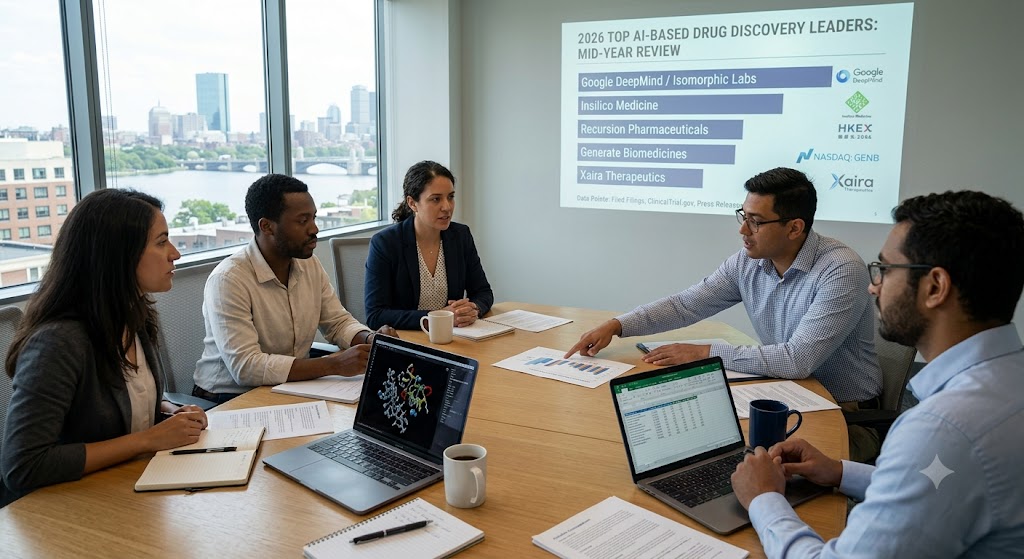
Five companies now dominate the conversation around AI-designed medicine, and in the past seven months, three of them have hit milestones that used to take a decade: a Hong Kong stock exchange debut, a Nasdaq IPO, and a $2.1 billion funding round. This is a side-by-side look at where the leading AI drug discovery companies — Google DeepMind / Isomorphic Labs, Insilico Medicine, Recursion Pharmaceuticals, Generate Biomedicines, and Xaira Therapeutics — actually stand as of mid-2026, based on filings, trial registries, and press releases rather than pitch decks.
Why This AI Drug Discovery Companies Comparison Matters Now
For years, “AI drug discovery” was mostly a promise. That changed on two fronts within a single winter. Insilico Medicine’s TNIK inhibitor rentosertib became the first AI-discovered molecule to enter a randomized Phase III trial, and two of the five companies on this list went public within nine weeks of each other. Capital markets are no longer betting on a concept; they’re pricing actual clinical and commercial data. That shift is why a straight comparison — not a marketing summary — is useful for anyone tracking the CDMO, biomanufacturing, or biopharma investment side of this space.
Quick Snapshot
- Insilico Medicine (HKEX: 3696) — listed in Hong Kong on December 30, 2025, raising $293 million.
- Generate Biomedicines (NASDAQ: GENB) — priced its IPO on February 26, 2026, raising $400 million.
- Isomorphic Labs — closed a $2.1 billion Series B on May 12, 2026, its second round led by Thrive Capital.
- Recursion Pharmaceuticals (NASDAQ: RXRX) — already public, now digesting its 2024 merger with Exscientia.
- Xaira Therapeutics — still private, sitting on more than $1 billion raised in a single 2024 round.
At a Glance: The Top AI Drug Discovery Companies Compared
| Company | Core AI Technology | Lead Program / Stage | Primary Strategy |
|---|---|---|---|
| Google DeepMind / Isomorphic Labs | AlphaFold 3, IsoDDE unified design engine | Undisclosed oncology candidate, targeting first-in-human by end of 2026 | Platform licensing to pharma + internal pipeline |
| Insilico Medicine | PandaOmics, Chemistry42, Biology42 (Pharma.AI) | Rentosertib (TNIK inhibitor, IPF) — Phase III | End-to-end internal discovery-to-clinic + licensing |
| Recursion Pharmaceuticals | Phenomics imaging + Exscientia’s precision chemistry | REC-1245 (RBM39 degrader) — Phase 1 | Scaled biology data + partnered pipeline |
| Generate Biomedicines | Generative Biology protein language models | GB-0895 (anti-TSLP antibody, severe asthma) — Phase 3 | Generative antibody/protein design, now public |
| Xaira Therapeutics | RFdiffusion, RFantibody, X-Cell virtual cell model | Preclinical antibody therapeutics; pipeline still forming | Foundation-model-first, pipeline follows the platform |
Google DeepMind / Isomorphic Labs: Structural Biology at Scale
Isomorphic Labs spun out of Google DeepMind in 2021 to commercialize AlphaFold’s protein-structure predictions for drug design. In February 2026 the company released IsoDDE, a unified engine that folds structure prediction, ligand binding, and antibody-antigen modeling into one system, reportedly roughly doubling AlphaFold 3’s accuracy on the hardest, least-similar ligand cases. Three months later, on May 12, 2026, Isomorphic closed a $2.1 billion Series B led by Thrive Capital, with Alphabet, GV, Temasek, MGX, CapitalG, and the UK Sovereign AI Fund also participating — bringing its total disclosed capital to roughly $2.6–2.7 billion.
The company already licenses its platform to Novartis, Eli Lilly, and Johnson & Johnson, deals collectively worth several billion dollars in potential milestones. Its own internal oncology and immunology candidates are still preclinical, however. CEO Demis Hassabis has pushed the timeline for Isomorphic’s first human trial back once already — from end-2025 to end-2026 — a reminder that platform depth and clinical execution are not the same thing.
Insilico Medicine: The First AI-Discovered Drug to Reach Phase III
Insilico Medicine is currently the clearest proof point that generative AI drug discovery can produce clinical results, not just faster screening. Its lead candidate, rentosertib (formerly INS018-055/ISM001-055), is a TNIK inhibitor for idiopathic pulmonary fibrosis discovered by the PandaOmics target-identification engine and designed by the Chemistry42 generative chemistry platform. The molecule went from target identification to a ready-for-testing preclinical candidate in roughly 18 months, using fewer than 80 synthesized compounds. Its Phase IIa results, published in Nature Medicine in June 2025, showed dose-dependent improvement in forced vital capacity against placebo decline. In July 2026, Insilico initiated a randomized, placebo-controlled Phase III trial enrolling 320 patients across 47 centers in China — the first AI-discovered molecule to reach that stage.
On the corporate side, Insilico listed on the Hong Kong Stock Exchange on December 30, 2025 (ticker 3696.HK), raising $293 million in what became 2025’s largest Hong Kong biotech IPO, backed by cornerstone investors including Eli Lilly and Tencent. The company reports more than 30 in-house programs and over a dozen molecules that have cleared IND filings, spanning fibrosis, oncology, and inflammatory disease.
Recursion Pharmaceuticals: Consolidating After the Exscientia Merger
Recursion built its reputation on phenomics — training AI on millions of cell-imaging datasets rather than starting from a single molecular target. Its November 2024 merger with Exscientia added precision chemistry and automated small-molecule synthesis, creating one of the more complete AI-to-clinic platforms in the public markets. But 2025 turned into a pipeline reset: in Q1 2025 the company deprioritized three clinical-stage programs, paused another, and wound down a preclinical effort to concentrate spending on oncology and rare disease. Shares fell over 13% the day the cuts were announced.
The company’s most-watched near-term readout is REC-1245, an RBM39 degrader for solid tumors and lymphoma, with Phase 1 dose-escalation data expected in the first half of 2026. Partnerships with Roche/Genentech, Bayer, Sanofi, and Merck KGaA have delivered roughly $450 million in upfront and milestone payments to date, against a total potential exceeding $20 billion. Per its most recent 10-K filing, Recursion held about $399 million in cash at the end of 2025 and guided 2026 operating cash expense below $390 million, with a stated runway into mid-2027.
Generate Biomedicines: Generative Protein Design Goes Public
Founded in 2018 by Flagship Pioneering, Generate Biomedicines treats drug discovery as a protein-generation problem: its Generative Biology platform designs new antibodies and proteins from scratch rather than screening existing molecule libraries. The company priced its IPO at $16 per share on February 26, 2026, raising $400 million — the largest biotech IPO of the year to that point — and began trading on Nasdaq under GENB the next day.
Its lead candidate, GB-0895, is a long-acting anti-TSLP antibody dosed once every six months, positioned against severe asthma (two Phase 3 trials that began enrolling in December 2025) and COPD (Phase 1b, with results expected later this year). The company’s pipeline also includes two earlier-stage oncology candidates. Generate holds multi-year collaboration agreements with Amgen (worth up to roughly $1.9 billion) and Novartis, and has banked close to $700 million in equity financing before the IPO. Like most newly public biotechs, it is not yet profitable: its S-1 disclosed a 2025 net loss of about $223 million against roughly $32 million in collaboration revenue.
Xaira Therapeutics: Best-Funded, Still Building Its Pipeline
Xaira launched in April 2024 with more than $1 billion in committed capital from ARCH Venture Partners and Foresite Labs — the largest initial funding commitment in ARCH’s history. Its scientific foundation comes from Nobel laureate David Baker’s University of Washington lab, whose RFdiffusion and RFantibody models can design novel proteins and antibodies computationally. The company is led by Marc Tessier-Lavigne, former chief scientific officer at Genentech, with a board that includes Nobel laureate Carolyn Bertozzi and former FDA commissioner Scott Gottlieb.
Unlike the other four companies, Xaira is deliberately platform-first: as COO Jeff Jonker has put it, the AI platform came before the pipeline, and the pipeline is still being built around it. In March 2026 the company released X-Cell, its first virtual cell model, trained on X-Atlas/Pisces — a 25.6-million-cell genome-wide perturbation dataset the company describes as the largest and most context-diverse of its kind. At 4.9 billion parameters, Xaira calls it the largest causal perturbation model built to date. The company is reportedly focused on antibody therapeutics in immunology and inflammation, though no clinical-stage candidate has been disclosed as of this writing.
Clinical Maturity Ranking Among AI Drug Discovery Companies
| Rank | Company | Most Advanced Stage | Notes |
|---|---|---|---|
| 1 | Insilico Medicine | Phase III (rentosertib, IPF) | First AI-discovered molecule to reach Phase III |
| 2 | Generate Biomedicines | Phase 3 (GB-0895, severe asthma) | Public since Feb 2026; funded through Phase 3 |
| 3 | Recursion Pharmaceuticals | Phase 1–2 (multiple programs) | Pipeline narrowed post-Exscientia merger |
| 4 | Isomorphic Labs | Preclinical, targeting first-in-human by end-2026 | Timeline already pushed back once |
| 5 | Xaira Therapeutics | Preclinical / platform-building | No clinical-stage candidate disclosed yet |
A note on this ranking
This reflects publicly disclosed clinical stage only, not the underlying strength of each company’s AI technology. Isomorphic and Xaira are earlier in the clinic in part because they launched their internal pipelines later, not because their platforms are weaker.
Funding & Market Strategy Snapshot
| Company | Status | Key Capital Event | Major Pharma Partners |
|---|---|---|---|
| Isomorphic Labs | Private | $2.1B Series B, May 2026 | Novartis, Eli Lilly, J&J |
| Insilico Medicine | Public (HKEX: 3696) | $293M IPO, Dec 2025 | Eli Lilly, Sanofi, Exelixis, Menarini |
| Recursion Pharmaceuticals | Public (NASDAQ: RXRX) | Exscientia merger, Nov 2024 | Roche/Genentech, Bayer, Sanofi, Merck KGaA |
| Generate Biomedicines | Public (NASDAQ: GENB) | $400M IPO, Feb 2026 | Amgen, Novartis |
| Xaira Therapeutics | Private | $1B+ launch round, Apr 2024 | None publicly disclosed |
What This Means for AI Drug Discovery Companies Going Forward
A pattern is emerging across these five companies, and it isn’t about whose algorithm is best. It’s about which ones have converted algorithmic output into clinical or commercial proof. Insilico and Generate both now have Phase 3-stage programs and public listings; both also had to disclose real losses and real trial risk to get there. Recursion’s pipeline cuts show that even a well-capitalized, technically sophisticated platform still has to make hard prioritization calls once cash burn meets clinical reality. Isomorphic and Xaira, by contrast, are still spending mostly on platform-building — which is exactly why their next 12–18 months matter more than their last two years of headlines.
For CDMOs, analytical instrumentation suppliers, and manufacturing partners watching this space, the practical signal is simple: as these programs move from Phase 1 into Phase 2 and 3, demand for GMP-grade synthesis, analytical method development, and scale-up capacity in oncology, immunology, and fibrosis indications is likely to follow — concentrated first around the companies that already have late-stage assets, namely Insilico Medicine and Generate Biomedicines.
What’s Coming Next in This Series
This article is the first in a six-part series examining how AI is reshaping the biopharmaceutical development lifecycle. Links will be added as each entry is published.
① Global Top-Tier Company Matrix
Compares technology, clinical pipelines, and market strategy across Google DeepMind/Isomorphic Labs, Insilico Medicine, Recursion, Generate Biomedicines, and Xaira Therapeutics.
You are reading this article now.
② FDA & EMA Global Regulatory Tracks
Analyzes the 10 Guiding Principles of Good AI Practice jointly issued by the FDA and EMA in January 2026, and how they apply in practice.
[Coming soon — link will be added on publication]
③ AI Across Modalities
Examines how AI is being applied to antibody-drug conjugates (ADCs), monoclonal antibodies, RNA therapeutics, and cell/gene therapies.
[Coming soon — link will be added on publication]
④ Strategic Shifts in the CDMO Market
Tracks AI integration and market shifts across global CDMO leaders including Lonza, Samsung Biologics, WuXi Biologics, Catalent, and PCI Pharma.
[Coming soon — link will be added on publication]
⑤ Next-Generation AI-Driven Clinical Trials
Investigates how digital twins and virtual control arms are restructuring clinical trial operations.
[Coming soon — link will be added on publication]
⑥ Forecasts Toward 2035
Presents data-driven scenarios and industry timelines based on current technological trajectories.
[Coming soon — link will be added on publication]
Frequently Asked Questions
Which AI drug discovery company has the most advanced clinical program?
Insilico Medicine currently leads, with rentosertib (INS018-055) for idiopathic pulmonary fibrosis in a Phase III trial that began in July 2026 — the first AI-discovered molecule to reach that stage.
Are Insilico Medicine and Generate Biomedicines publicly traded?
Yes. Insilico Medicine listed on the Hong Kong Stock Exchange on December 30, 2025 under ticker 3696.HK. Generate Biomedicines listed on Nasdaq on February 27, 2026 under ticker GENB.
Is Isomorphic Labs publicly traded?
No. As of mid-2026, Isomorphic Labs remains privately held, majority-owned by Alphabet, and most recently raised $2.1 billion in a Series B round rather than pursuing an IPO.
What makes Xaira Therapeutics different from the other four companies?
Xaira is explicitly building its AI platform, including the X-Cell virtual cell model, before finalizing its drug pipeline, whereas the other four companies already have named clinical or late-preclinical candidates.
This article is for general industry and business information purposes only and does not constitute investment, medical, or regulatory advice. Clinical trial stages, financial figures, and corporate developments referenced above reflect publicly available information as of the stated dates and are subject to change; readers should verify current status through company filings, clinicaltrials.gov, or the original sources linked in this article before making any decisions based on this content.