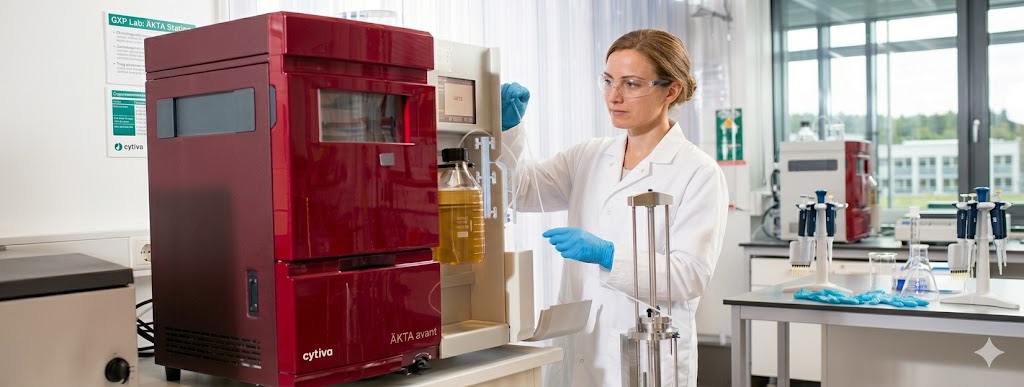
Short version: the AKTA avant 25 isn’t a downstream purification solution by itself — it’s the method-development instrument that determines whether the purification you scale up later actually works. That distinction matters more than most equipment write-ups admit.
What This System Actually Is
According to Cytiva’s own product specifications, the AKTA avant 25 runs at flow rates up to 25 mL/min and is positioned specifically for chromatography resin screening and method optimization — the small-scale development work that happens before a process is ever run at production volume.[1] Its sibling instrument, the AKTA avant 150, handles flow rates up to 150 mL/min and is the one actually used for scale-up work; commercial-volume runs typically move to larger platforms like AxiChrom columns entirely.
That’s worth stating plainly because a lot of equipment content blurs this line — implying a single benchtop system single-handedly represents “a CDMO’s downstream purification strategy.” It doesn’t. What it represents is the front end of that strategy: getting the separation chemistry right before anyone commits column volume, buffer cost, or cytotoxic payload to a larger run.
Why This Matters More for ADCs Than for a Standard Antibody
The core purification problem in an ADC process is separating conjugation by-products — antibody molecules with too few or too many drug molecules attached — from the target species. Get this wrong at small scale and you either discard a batch downstream or, worse, don’t catch it until release testing.
Two things make this harder than standard monoclonal antibody purification:
- Containment. ADC downstream work involves cytotoxic payloads, so the process has to be developed and run with full containment from the earliest development steps — not retrofitted in once the process moves to pilot scale.
- Scale-up fragility. Chromatography conditions that work cleanly on a benchtop column don’t always survive the jump to a packed production column. Pressure distribution changes, and resolution that looked sharp at small scale can degrade once you’re running a column an order of magnitude larger.
Where a Screening Instrument Fits in the Larger DSP Stack
No single instrument covers the full downstream path. Here’s roughly how the stages break down, and what each one is actually solving for:
| Stage | What’s Being Solved | Typical Tool Class |
|---|---|---|
| Method development / resin screening | Finding the separation chemistry that isolates target DAR species | Small-scale automated systems (e.g., AKTA avant 25) |
| Scale-up / robustness testing | Confirming the method survives higher flow rates and larger columns | Higher-flow benchtop systems (e.g., AKTA avant 150) |
| Commercial-scale purification | Running the validated method at production volume | Large packed columns with axial compression |
| In-process monitoring | Confirming elution timing and purity in near-real time | In-line density/UV/PAT sensors |
Skipping the first stage, or treating it as an afterthought, is where most scale-up failures actually originate — not at the production column itself.
What This Looks Like in an Audit
The regulatory interest isn’t in the hardware — it’s in whether the resulting data can be trusted and traced back to a specific run. Under 21 CFR Part 11, electronic records and signatures generated by systems like this one need to be attributable, time-stamped, and protected against undetected alteration in order to be treated as equivalent to paper records and handwritten signatures.[2] In practice, that means the software controlling the run — not just the chromatogram it produces — needs a locked audit trail showing who changed what, and when, before that data can support a regulatory submission.
This connects directly to the analytical side of the process: once a purification method is locked in, the DAR uniformity it produces still needs to be verified by the kind of orthogonal methods covered in our CQA framework for ADC manufacturing piece — chromatography alone doesn’t close the loop on quality.
The Practical Limits Worth Knowing
A few things this kind of instrument doesn’t solve, regardless of how well the method development goes:
- It doesn’t guarantee scale-up success. A clean separation at 25 mL/min is a strong signal, not a guarantee, that the same chemistry holds at production flow rates and column dimensions.
- It’s a shared capital resource in most labs. Because it’s used across multiple programs for screening, scheduling contention is a real constraint in facilities running several molecules in parallel — worth accounting for in a development timeline, not just a capital budget.
- It doesn’t replace containment infrastructure. For genuinely high-potency payloads, the surrounding biosafety and containment setup matters as much as the chromatography system itself.
The Practical Takeaway
Method-development chromatography gets far less attention than the production-scale hardware it eventually feeds into, but skipping or rushing it is where a surprising share of downstream failures actually start. If you’re scoping a CDMO partner or building an internal DSP timeline for an ADC program, the honest question to ask isn’t “what production-scale equipment do you have” — it’s “how much dedicated screening time does a new molecule get before it touches a production column.”
If you’re evaluating downstream purification strategy or CDMO analytical capability for a bioconjugate program, feel free to reach out.