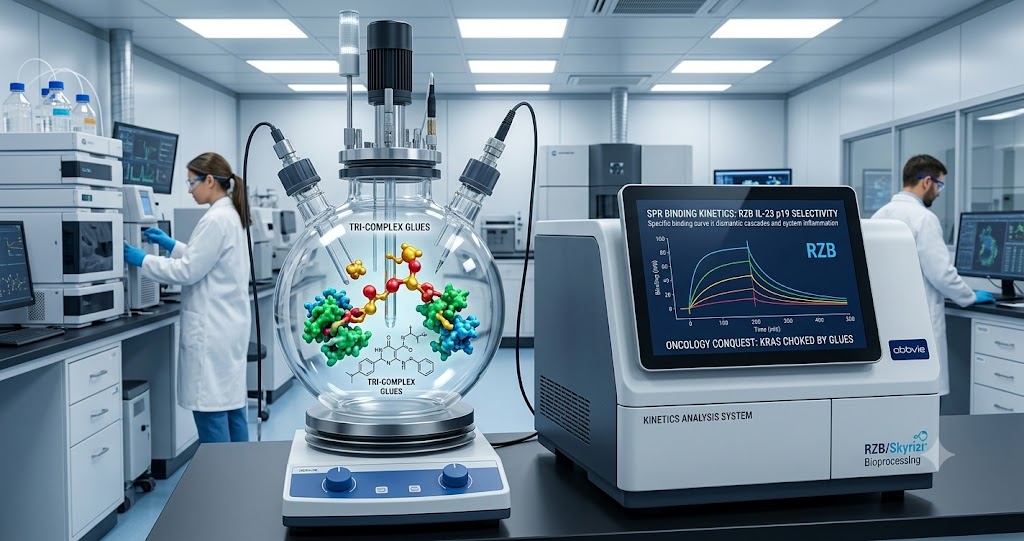
Executive Summary: This review examines two of 2026’s most consequential biopharma breakthroughs — tri-complex RAS inhibitors in oncology and IL-23 blockade in immunology — and the analytical instrumentation reshaping how both are characterized and manufactured.
1. Tri-Complex Inhibitors: Breaking the ‘Undruggable’ Barrier in Pancreatic Oncology
For decades, the standard prognosis for metastatic pancreatic ductal adenocarcinoma (mPDAC) has been a grim, terminal timeline. Specifically, the primary driver has always been the KRAS mutation. This oncogene is found in over 90% of pancreatic cancer cases. Consequently, because of its slippery molecular structure and lack of accessible binding pockets, the world’s brightest chemistry labs routinely deemed it utterly “undruggable.”
This year, however, that historical dogma has officially collapsed.
The American clinical-stage oncology company Revolution Medicines has fundamentally altered the standard of care. In fact, they achieved this via their flagship pipeline asset, Daraxonrasib (RMC-6236). Unlike first-generation KRAS inhibitors that only locked the inactive state of the protein, Daraxonrasib works through a tri-complex inhibitor mechanism, sometimes described as a “molecular glue.” Therefore, by forming a complex with intracellular Cyclophilin A, it simultaneously shuts down multiple active, GTP-bound RAS variants.
📊 Phase 3 Data: The RASolute 302 Global Trial
In the Phase 3 RASolute 302 global trial (announced April 13, 2026), Daraxonrasib achieved an unprecedented medical milestone. It nearly doubled median overall survival (OS) for patients with previously treated metastatic pancreatic cancer to 13.2 months, versus 6.7 months for standard-of-care chemotherapy (hazard ratio 0.40, p<0.0001) — a 60% reduction in the risk of death. Official registry details can be tracked via ClinicalTrials.gov (NCT06625320).
■ The Paradigm Shift in Patient Care
For families and clinicians searching for a legitimate pancreatic cancer drug breakthrough, this represents a major therapeutic shift. The treatment moves away from toxic broad-spectrum intravenous infusions. Instead, it introduces a highly targeted, once-daily oral tablet regimen, with a safety profile Revolution Medicines has described as generally well tolerated and manageable, with no new safety signals reported. (Note: specific discontinuation-rate figures should be verified against the original press release before publication.)
■ Analytical Instrument Engineering for Tri-Complex Characterization
Following these readouts, Revolution Medicines has stated it is moving with urgency toward global regulatory submissions for Daraxonrasib. Updates can be tracked via the U.S. FDA Newsroom.
From an instrumentation standpoint, validating the binding kinetics of multi-RAS targeted tri-complex inhibitors requires state-of-the-art laboratory techniques. Analysts utilize high-throughput Surface Plasmon Resonance (SPR) spectroscopy to verify the precise association and dissociation constants ($K_D$) of the tri-complex. Moreover, laboratories are expanding their reliance on automated mass spectrometry workflows to characterize rare RAS variant profiles across patient subgroups.
2. Beyond Tri-Complex Inhibitors: Why AbbVie’s RZB Is Consolidating the Immunology Market
While oncology undergoes a structural rebirth, the multi-billion-dollar immunology sector is witnessing an aggressive consolidation of power. Currently, the shorthand on every major bioprocessing and analytics lab manager’s lips is RZB — the established medical abbreviation for Risankizumab, marketed globally as Skyrizi by AbbVie.
Mechanistically, RZB is a high-affinity humanized immunoglobulin G1 (IgG1) monoclonal antibody. Specifically, it selectively binds to the p19 subunit of the interleukin-23 (IL-23) cytokine, dismantling the chronic cascade responsible for systemic inflammation.
Having already secured a strong position in adult plaque psoriasis and psoriatic arthritis, AbbVie is executing an aggressive expansion into both the gastroenterology and pediatric markets globally.
The Phase 3 AFFIRM Study
This pivotal study (announced March 2, 2026) evaluated RZB as a subcutaneous (SC) induction therapy in adults with moderately to severely active Crohn’s disease. RZB achieved a 55% clinical remission rate versus 30% for placebo, and a 44% endoscopic response rate versus 14% for placebo, at week 12 (both p<0.0001).
Expanding the Bio-Manufacturing Moat
On June 26, 2026, the U.S. FDA approved RZB for pediatric patients (ages 6 and older) with moderate-to-severe plaque psoriasis and active psoriatic arthritis. This rollout introduces a weight-based 55 mg pre-filled syringe for patients under 40 kg, making RZB the first IL-23 inhibitor approved for this pediatric weight class in the US.
Bioseparation and Quality Control Techniques
Analytical Purification Criteria: Isolating humanized IgG1 monoclonal antibodies like RZB requires robust bioseparation protocols. For instance, quality control laboratories rely heavily on Size Exclusion Chromatography (SEC-HPLC) and Hydrophobic Interaction Chromatography to monitor aggregate formation and batch purity. Meanwhile, Janssen has opened enrollment for its Phase 3b CHARGE study (NCT07499232), a head-to-head trial comparing guselkumab against risankizumab in Crohn’s disease — a sign that RZB’s manufacturing and efficacy benchmark is now the standard rivals must clear.
3. Future Horizons: Predictive Evolution of Bio-Pharma Instrumentation and Pipelines
In the modern bio-pharma landscape, the trajectory of therapeutic development is dictated by the limits of precision measurement. As molecular complexities scale, future pipeline dominance will shift toward organizations that integrate advanced instrumentation workflows.
| Analytical Vector | Predictive Technological Shift |
|---|---|
| Next-Gen Oncology Analytics | The rapid expansion of multi-RAS targeted oral inhibitors will accelerate demand for ultra-precise tertiary protein structural mapping. Specifically, laboratories are projected to shift from traditional X-ray crystallography toward automated Cryo-Electron Microscopy (Cryo-EM) and high-resolution MS/MS characterization pipelines to screen RAS variant subgroups before multi-center clinical stages. |
| Automated Bioprocessing Control | As blockbusters like RZB establish clinical benchmarks for mucosal healing, competing antibody architectures must drastically reduce production-stage micro-heterogeneity. Consequently, the industry is transitioning toward continuous bioprocessing systems embedded with Process Analytical Technology (PAT). Real-time online HPLC monitoring and multi-angle light scattering (MALS) are becoming standard tools for ensuring glycosylation uniformity and downstream purity. |
Conclusion: The Technology Driving Clinical Outcomes
Ultimately, the biopharmaceutical entities that control the active KRAS tumor microenvironment and the IL-23 pathway command the future of high-margin medicine. Therefore, for engineering professionals and lab managers alike, the true future layout is decided by the analytical instruments capable of characterizing these complex structures in real time.
If you require professional tailored technical consulting on bio-pharma market trends, clinical analysis, or digital publishing strategies for high-CPC healthcare vectors, please contact our specialist division.