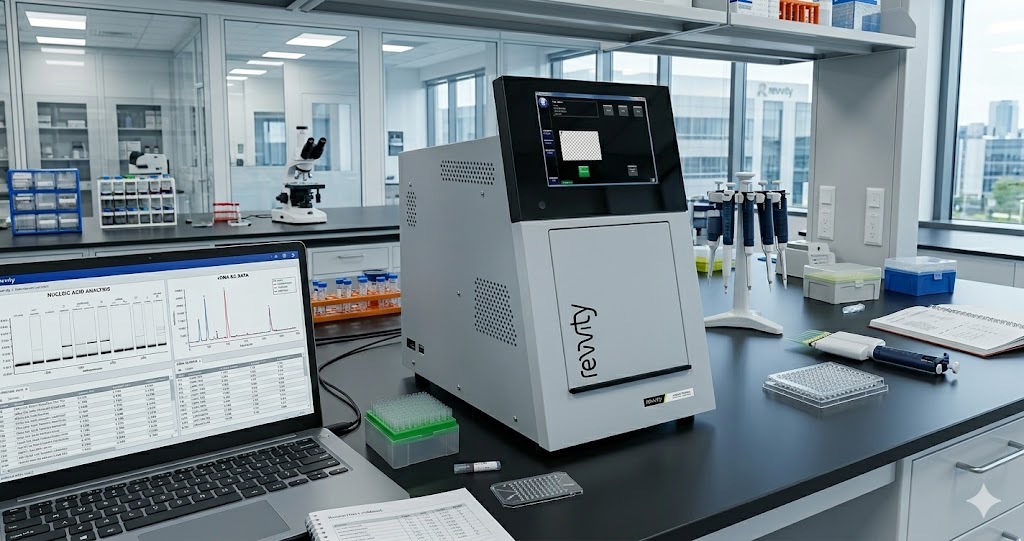
Most nucleic acid QC bottlenecks in a CDMO don’t come from the bioreactor. They come from the bench next to it, where a technician is still waiting on a gel to run. Microfluidic capillary electrophoresis systems were built specifically to remove that wait, and the LabChip GX Touch is one of the platforms that has become common in upstream and QC labs handling plasmid, mRNA, and viral vector work.
This piece looks at what the system actually replaces, where it fits into a regulated workflow, and what auditors tend to ask about once it’s installed.
What a Gel-Based Workflow Actually Costs You
Agarose gel electrophoresis is still standard in many labs because it’s cheap and well understood. Its cost shows up in time, not reagents. Casting, running, staining, and destaining a gel typically takes somewhere between two hours and most of a working day, depending on the assay and how many samples are queued.
In a facility running multiple upstream and downstream lines in parallel, that lag becomes a scheduling problem: purification steps wait on QC results that themselves are waiting on gel turnaround. Revvity, the manufacturer, states that the LabChip GX Touch can complete a full analysis of a genomic sample in as fast as 30 seconds using automated capillary electrophoresis instead of slab gels. That’s the core trade the system is built around: less hands-on time per sample, at the cost of a higher upfront instrument price than a gel rig.
Where It Gets Used in Practice
Three points in a typical process are where this kind of instrument tends to get deployed:
| Process Stage | What’s Being Checked | Why Speed Matters Here |
|---|---|---|
| Plasmid / cDNA cloning | Insert size and vector integrity before scale-up | Catching a bad clone early avoids wasting a full cultivation run on it |
| mRNA in-vitro transcription (IVT) | Transcript integrity and smear pattern, which flags degradation | IVT batches degrade quickly; a slow QC method can miss the window to intervene |
| Pre-formulation / final DSP | Residual host cell DNA levels | This is a release-testing checkpoint, not just an in-process one |
None of this is unique to one vendor’s hardware — any validated microfluidic CE system does roughly the same job. What varies between platforms is throughput format (96- vs 384-well), sample volume requirements, and how the accompanying software handles audit trails.
What This Looks Like in an FDA Audit
The regulatory interest isn’t in the hardware itself — it’s in whether the data it produces can be trusted and traced. FDA’s Computer Software Assurance (CSA) guidance, finalized in September 2025, pushes toward a risk-based approach to validating this kind of production and QC software rather than exhaustively scripted testing of every function. In practice, that means an auditor is less likely to ask “did you test every menu item in the software” and more likely to ask whether you can demonstrate, with evidence, that the system reliably does what it’s used for — with a locked, time-stamped record of who ran what and when.
For instruments feeding into a nucleic acid QC step specifically, the two things worth having documented before an inspection are: (1) how electronic signatures and access control are configured on the instrument software, and (2) how the low sample-volume requirement (typically in the 1–2 µL range for these systems) is handled procedurally when working with limited or precious material.
What It Doesn’t Solve
It’s worth being direct about the limits. A microfluidic CE system tells you size and approximate concentration — it does not replace sequencing for confirming identity, and it does not replace potency or functional assays. Teams sometimes treat a clean electropherogram as a green light to proceed when the actual risk (a point mutation, for example) wouldn’t show up on this kind of sizing analysis at all. It’s a screening and QC tool, not a full characterization method.
Cost is the other practical constraint. The instrument and per-sample consumable cost are both higher than gel electrophoresis. For a lab running a handful of samples a week, the time savings may not justify the capital outlay; the case gets stronger as sample throughput increases.
The Practical Takeaway
The decision to move from gel-based nucleic acid QC to a microfluidic CE platform usually comes down to one question: is analytical turnaround currently the bottleneck in your process schedule? If gel runs are stacking up and delaying downstream decisions, the time savings are real and documented by the manufacturer’s own specifications. If throughput is low and budget is tight, a well-run gel workflow with disciplined SOPs can still meet the same data integrity bar — it just takes longer per sample.
This article discusses general product category considerations for nucleic acid analytical instrumentation based on manufacturer-published specifications and publicly available FDA guidance. It is not sponsored by, or written in partnership with, any equipment manufacturer.
If your team is evaluating analytical instrumentation choices as part of a tech transfer between sites — including how to document CSA-aligned validation for a newly introduced system — feel free to reach out.