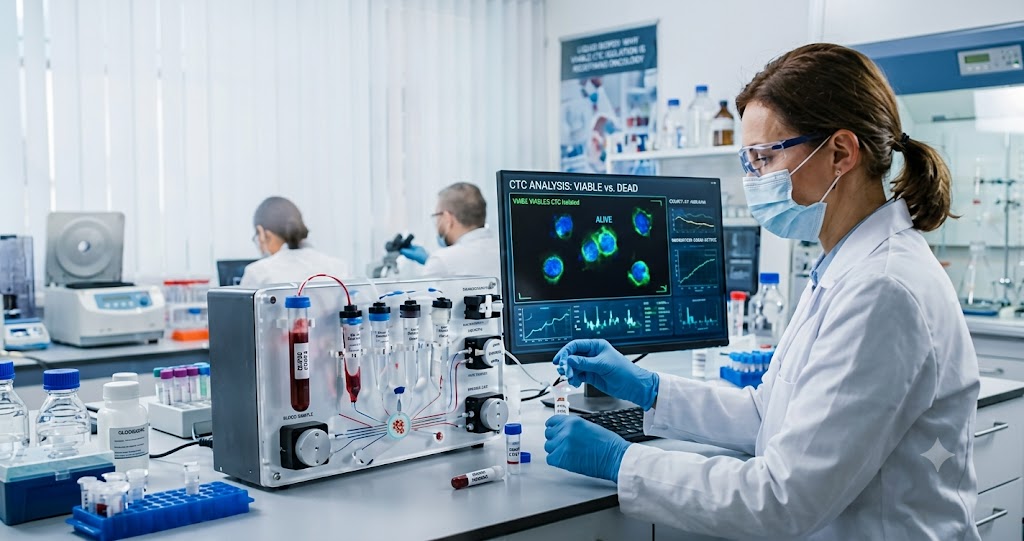
The global oncology market is facing an aggressive reallocation of capital. For nearly a decade, liquid biopsy investments heavily favored standard circulating tumor DNA (ctDNA test) infrastructures. However, as next-generation targeted modalities like ADCs and PROTACs dominate pipelines in 2026, the structural limits of sequencing fragmented, dead genetic materials have exposed severe clinical gaps. Leading biomedical institutions are rapidly pivoting toward live cell oncology—specifically leveraging advanced Viable CTC Capture platforms like ANGLE Parsortix® and CytoGen HDM Chip—to secure the vital cytological architecture required for real-time drug screening and to mitigate catastrophic multi-billion dollar clinical trial wreckage.
1. Beyond Genetic Fragments: Bursting the ctDNA Bubble for ‘Living Cytology’
Cancer is an evolving, predatory cellular ecosystem that cannot be fully deciphered by static genomic charts. The definitive breakthrough driving high-throughput rare cell isolation in 2026 is undamaged, label-free ‘Viable CTC Capture.’
Extracting circulating tumor cells from a patient’s bloodstream completely intact allows clinical developers to evaluate live morphology and protein expressions outside the human body. By tracking real-time dynamic variations at the single-cell level, research pipelines can map out comprehensive ‘Tumor Heterogeneity Matrices’—a crucial capability required to track and neutralize aggressive metastatic pathways before they blindside clinical developments.
2. Global Competitive Landscape: Disruptive Technical Positioning
To secure high-margin big pharma licensing deals and cross-border partnerships, clarifying technical differentiation against legacy standards is vital. The global rare cell screening landscape has officially fractured into two competing methodologies:
| Classification | Marker (Antibody)-Based Systems | Physical (Size)-Based Platforms |
|---|---|---|
| Examples (System) | Menarini – CELLSEARCH® | ANGLE – Parsortix® / CytoGen – HDM Chip |
| Isolation Mechanism | Legacy chemical binding using specific cell-surface antibodies (EpCAM) | Label-free microfluidic filtration exploiting distinct cell size and deformability dynamics |
| Limitations & Advantages | Completely misses highly aggressive cancer cells undergoing EMT phenotypic shifts; severe risk of altering cell viability during chemical extraction. | Harvests pristine, unaltered living cells across diverse oncological profiles. Crucially, proprietary High-Density Microporous Chip (HDM Chip) architectures eliminate damaging fluidic shear stress to secure optimal cell survival rates for immediate downstream multi-omics analysis. |
3. The 2026 Regulatory Shockwave: FDA’s Ultimatum on Laboratory Developed Tests
The absolute center of monetization gravity in the US market has shifted due to the sweeping Laboratory Developed Tests (LDTs) enforcement strategy deployed by the US FDA.
The era of commercial laboratories (CLIA Labs) running unapproved internal diagnostic assays with impunity is over. In 2026, the FDA enforces comprehensive alignment, forcing LDT assets to clear the exact same rigorous validation protocols as standard In Vitro Diagnostics (IVD platforms).
Basic “in-lab analytical replication data” will no longer guarantee US market survival. Liquid biopsy architectures that fail to demonstrate direct, repeatable ‘Clinical Utility’ across major CLIA lab networks face immediate market exclusion.
4. Capturing the Ultimate High-Margin Asset: Companion Diagnostics (CDx) Integration
The most aggressive revenue-generating engine in modern biotech is not retail diagnostic volume—it is embedding next-generation Companion Diagnostics (CDx Development) frameworks directly into global pharmaceutical pipelines.
① Real-Time Ex Vivo Drug Screening
By integrating high-efficiency label-free CTC isolation architectures during early-phase clinical protocols, developers can challenge patient-extracted living tumor cells with experimental drug assets ex vivo before clinical dosing occurs.
② De-risking Oncology Pipelines
Securing pinpoint patient stratification parameters mirrors the massive corporate success of tissue-based CDx giants. This tactical precision insulates multi-million dollar biopharma clinical programs from unexpected efficacy failures.
Conclusion: Navigating the Billion-Dollar Pivot in Precision Oncology
The narrative built entirely around cell-free genetic debris has reached its expiration date; the industry demands cellular resolution. Surviving the strict 2026 FDA LDT mandates and solidifying dominant CDx infrastructure via advanced HDM chip-driven frameworks is the only viable pathway for enterprises looking to dictate the commercial terms of the global liquid biopsy sector.
If you require expert technical consultation regarding Viable CTC-based collaborative research, technology licensing partnerships, or Companion Diagnostics (CDx) pipeline development, please contact our specialist division immediately.